
Dear friend of FAI,
I’m excited to share with you our recent work at the Foundation for American Innovation. It’s been an energetic quarter, and the team continues to strengthen national security, improve American governance, and keep America at the forefront of technological dynamism.
FAI is getting ready for our American Innovation Gala on October 1 in Washington, DC. It will be an evening honoring the people and ideas shaping the future of the American experiment. Keynote speakers include Shyam Sankar, Chief Technology Officer and Executive Vice President of Palantir Technologies, and inventor, author, and futurist Ray Kurzweil. Tickets and sponsorships are available; we hope you can join us.
We recently launched Frontier Legal Defense. This new project will defend America’s leading edge in artificial intelligence and other transformative emerging technologies from government overreach and novel legal threats while preserving alignment with the national interest. The project will be led by FAI General Counsel Tim Hwang.
We recently announced that Senior Fellow Dean Ball is joining OpenAI as Head of Strategic Futures. Dean will stay on with FAI as a non-resident senior fellow.
The team continues to grow. This quarter we welcomed External Relations Manager Josefina Cuddeback, AI Program Manager Wrena Sproat, Technology and Statecraft Program Manager Una Blumberg, Operations Associate Matthew Smyser, Staff Engineer Arielle Moore, Research Fellows Geneva Kirk Drayson, and Vinny Pimpale, Non-Resident Senior Fellow Andrew C. Johnston, and Non-Resident Fellow Jacob Bruggeman.
We also have a number of positions open—if you think you might be a good fit, please consider applying.
A bigger team needs a bigger office, and we recently moved into our new DC headquarters on Capitol Hill. We’re looking forward to hosting an officewarming party in the coming months.

Research
Reports, Comments, and Testimonies
FAI’s experts represented one of three organizations working with Anthropic on a review of model behaviors around freedom of expression, including political conversations, as part of Anthropic’s work on election safeguards.
The FAI team recently launched a new Physical Intelligence project. The revolution in digital machine intelligence is thoroughly underway, but the counterpart of this revolution in the physical world has barely begun. To address this lacuna, the project will pursue four goals: creating a favorable regulatory and legal climate for experimentation with autonomous technologies in the physical world; understanding the technical trajectory of robotics; articulating the industrial strategy to ensure that the core technologies of physical autonomy are designed and manufactured in the U.S. or its allies; and developing policy frameworks for liability, cybersecurity, and similar areas of the emerging law of robotics.
To support the launch of this project, Non-Resident Fellow Amelia Michael and Research Fellow Emerson Alden published “The State of Industrial Robotics.” They assess the market for industrial robots, concluding that while the U.S. is not competitive in industrial robot manufacturing today, Japan and Europe are, and most components remain available outside China. This leaves room for a non-Chinese industrial robotics supply chain, but only if the U.S. and its allies can keep pace as the industry moves toward greater AI integration.
Tim published “Going on Wartime Footing: Five Big Reforms for American Defense.” He presents five ideas for how the Department of War can dramatically address the problems facing America’s teetering defense industrial base. Each reform addresses a different bottleneck in the defense system: talent, competition, leadership accountability, procurement incentives, and grassroots innovation.
President and CEO Zach Graves, Dean, and Senior Fellow Josh Wentzel led an open letter, signed by major AI lab CEOs, in support of mandatory nucleic acid synthesis screening and recordkeeping. They warn that AI creates a risk that the knowledge barriers that have historically prevented bad actors from obtaining biological weapons will meaningfully erode, and they call on Congress to act this session. The letter received write-ups in The Wall Street Journal, Wired, The Verge, and elsewhere.
Director of Technology and Statecraft Josh Levine and Senior Fellow Luke Hogg published “The Mobile Trilemma: How Tradeoffs among Innovation, Privacy, and Security Affect the Mobile Ecosystem.” They propose the “mobile trilemma” as a framework for understanding competition in smartphones: privacy, security, and integration are all valuable, but efforts to prioritize one dimension often constrain the others. By articulating the tradeoffs among the three, the trilemma can help identify policies that promote competition and consumer welfare within the mobile ecosystem.
Senior Fellow Emmet Penney contributed an essay to The Claremont Review of Books reviewing several books on how China overtook the U.S. He argues that the older deal between the two countries—America gives China its industrial base and manufacturing know-how; China gives America cheap goods—has caused both regimes to face legitimacy crises.
FAI scholars contributed three essays to the latest issue of American Affairs. In “Addition over Obstruction: A New Governing Principle for Energy Development,” Policy Advisor Pavan Venkatakrishnan argues for a governing commitment to building projects at the scale our ambitions demand, disciplined by markets and environmental substance rather than ideological veto. In “National Orchestration and Provincial Competition: China’s Industrial Policy for AI Dominance,” Non-Resident Fellow Farrell Gregory and Director of Artificial Intelligence Policy and Chief Economist Sam Hammond consider how AI-focused industrial policy is orchestrated and what the subnational dynamics between China’s provinces, municipalities, and central government reveal about their model of AI development. And in “The Long March of Process: Efficiency and its Discontents,” Emmet reviews Brian Potter’s book The Origins of Efficiency and considers the prospects for an industrial renaissance in the U.S.
Research Fellow Sophia Bulla published “Continent of Contradictions: How European Digital Regulations Fail on Their Own Terms.” She argues that the EU’s Digital Markets Act and Digital Services Act struggle with internal contradictions by attempting to force companies to provide all the benefits of their technology with none of the costs. The EU’s experience does not show that all attempts to regulate major tech firms are in vain, however; Sophia argues that recognizing the constraints and tradeoffs of digital regulations’ various goals can improve the quality of platforms and the contestability of markets.
Research Fellow Soham Mehta submitted comments to the National Institute of Standards and Technology’s National Cybersecurity Center of Excellence on its concept paper about AI agent identity and authorization. He proposes a framework for binding agent permissions to human-declared intent, preventing prompt injection, and enabling accountability across multi-agent and multi-domain deployments.
Josh Levine, Sam Hammond, Tim, Luke, former Research Fellow Sam Roland, and Research Fellow Blaine Dillingham submitted a comment in response to the General Services Administration’s proposal for rewriting the contract terms for how every agency buys AI through the government's largest commercial marketplace. They argue that the proposed clause tries to solve too many problems at once, regardless of use case or risk.
Tim, with help from Sam Roland, filed an amicus brief in support of the government in Department of the Air Force v. Prutehi Guahan, a critical case that will help push back against the overreach of NEPA.
We submitted several written testimonies to congressional appropriations committees:
- Managing Director for Policy Robert Bellafiore submitted testimony to the House and Senate Subcommittees on Labor, Health and Human Services, Education, and Related Agencies, recommending that the Department of Education strengthen its efforts identifying and supporting exceptional students in K-12.
- In testimony to the same subcommittees, Senior Fellow Dan Lips called for increasing the return on investment from education R&D to benefit American students.
- In testimony to the House Subcommittee on National Security, Department of State, and Related Programs, Luke called for funding the Open Technology Fund, which supports technologies that help people living under authoritarian censorship securely access the internet.
- In testimony to the House Subcommittee on National Security, Department of State, and Related Programs, Dan recommended that the State Department evaluate the potential for using a civics-based screening as part of the vetting process for student visas and exchange visitor visas.
- In testimony to the House Subcommittee on Labor, Health and Human Services, Education, and Related Agencies, and the Senate Subcommittee Commerce, Justice, Science and Related Programs, Dan recommended that the National Science Foundation promote advanced talent development in STEM education.
- In testimony to the Senate Subcommittee on the Legislative Branch, Dan offered recommendations for making the Government Accountability Office a more effective watchdog and strengthening its ability to save taxpayer dollars.
- In testimony to the Subcommittee on Financial Services and General Government, Dan recommended new reporting requirements for the Treasury Department and the Pandemic Response Accountability Committee to identify opportunities for Congress to reduce fraud and misspending.
Impact
Policies that our scholars have engaged on saw progress this quarter.
The announcement from the White House and Department of Commerce to invest $2 billion across seven quantum computing companies and two domestic quantum foundries is a major step toward cementing U.S. leadership in quantum technologies. The news validates the case that Josh Levine and Non-Resident Senior Fellow Prineha Narang have made over the last year, including in their four-part series in War on the Rocks.
Director of Energy and Infrastructure Thomas Hochman and Pavan’s work on permitting certainty contributed to the bipartisan introduction of the FREEDOM Act, led by Senators Cotton and Cortez-Masto. The bill represents a major contribution to permitting certainty, leveraging a private right of action for unreasonable delay and limitations on revocations and cancellations.
Thomas’s proposals for administrative NEPA reforms were reflected in CEQ’s latest categorical exclusion guidance, which notes that new categorical exclusions can be designated based on past environmental assessments’ “finding of no significant impact,” and defines the new standard for categorical exclusions (“normally does not have a significant effect”) as an action that does not have a significant effect “considerably more often than not.”
Sam Roland was a key player in the successful effort to revoke the nuclear moratorium in New Jersey, testifying to the state legislature, coordinating with the governor’s office to identify supporters, and helping to provide supporting information to state legislators.
Josh Levine has argued that, given autonomous vehicles’ safety improvements in recent years, robotaxis’ stalled deployment in Washington, DC, has largely been due to misguided concerns, special-interest pressures, and bureaucratic proceduralism. In a welcome shift, Councilmember Charles Allen recently introduced a bill to allow driverless ridesharing to the city.
In the report accompanying the FY2027 State and Foreign Operations funding bill, the House Appropriations Committee encouraged the U.S. International Development Finance Corporation to prioritize undersea cable financing in the Indo-Pacific to counter PRC competition. This reflects Josh Levine’s warnings that submarine cable infrastructure is a national security priority, given the expansion of Chinese firms’ cable footprint and associated infrastructure risks.
The House Appropriations Committee's report accompanying the FY2027 Commerce, Justice, Science funding bill directed NIST to address emerging threats posed by quantum computing by developing cryptographic standards and algorithms, and to strengthen domestic semiconductor manufacturing. The Committee also directed CHIPS R&D investments toward supply chain vulnerabilities and manufacturing equipment innovation necessary for quantum computing leadership. These priorities align directly with FAI’s quantum portfolio. The report also emphasized NSF's commitment to high-performance computing supporting AI and quantum, consistent with FAI's response to the Department of Energy's Genesis Mission request for information.
In the same report, the Committee directed NASA to maximize acquisition of commercial space-based data and fund a pilot program for commercial space science data procurement, consistent with Tim and Josh Levine's recommendations for building out private-sector access to structured federal government data to accelerate American AI development.
In May, GAO issued two reports showing that implementing its open recommendations for federal agencies and Congress could save hundreds of billions of dollars. For the past several years, FAI scholars have encouraged Congress to direct GAO to provide estimates of potential savings to increase transparency about what Washington wastes by ignoring GAO’s recommendations. These reports were mandated in annual spending and defense bills in 2022 and continue to highlight opportunities to increase government efficiency.
Relatedly, the House Appropriations Committee approved a report accompanying the FY2027 funding bill for the legislative branch that emphasizes the Committee’s interest in a GAO pilot project to establish timeframes for recommendation implementation. FAI has long recommended that GAO set deadlines on recommendations. The Committee's report also directs GAO to take further steps to eliminate waste, fraud, and abuse, in line with Dan and Director of American Governance Soren Dayton’s recommendations.
The Trump administration issued a proposed rule that would require states to use pre-vetting measures, such as the Treasury Department's Do Not Pay tool, to screen beneficiaries before they are paid to prevent fraud and misspending. Dan has called for strengthening Do Not Pay and recommended that governors use it to lead a national crackdown on government fraud.
In line with Luke’s recommendations, The Department of War announced that Chinese optical transceiver manufacturer Zhongji Innolight has been added to the 1260H list of Chinese military companies operating in the U.S. Getting added to this list is the first step towards broader sanctions and bans.
Research Fellow Daniel King has recommended that the Department of Labor prioritize workforce training for the skilled trades needed to build data centers and associated electric generation, transmission, and distribution. To that end, the House Appropriations Committee’s report for the FY2027 Labor, Health and Human Services, Education, and Related Agencies appropriations bill encourages the Employment and Training Administration to prioritize industry-vetted training partnerships and registered apprenticeship expansion for “AI infrastructure trades” and requests an update in the FY2028 congressional justification on actions taken to improve such training programs.
Daniel provided technical assistance on the Deterring American AI Model Theft Act of 2026, which aims to prevent unauthorized distillation of proprietary AI models. The House Committee on Foreign Affairs has voted unanimously to advance the bill.
Sam Roland’s work on state permitting dashboards has helped lead to a number of state-level wins, with Tennessee and New Jersey adopting large portions of FAI’s proposed permitting dashboard framework. New Jersey recently opened applications for the pilot phase of the Permitting Dashboard, with up to 10 projects from the energy, commercial, and multi-family housing sectors to be selected.
Early-stage trial acceleration is a major goal of FAI's Clinical Trials Abundance effort. The FDA recently announced a pilot program to accelerate early-stage clinical trials, projecting a 6–12 month reduction in development timelines, with a congressional request to make it permanent.
The Department of Justice intervened in xAI v. Weiser to enjoin Colorado’s Consumer Protections for Artificial Intelligence Act—the first time DOJ has moved to invalidate a state AI law. This follows Dean’s argument that DOJ should challenge the most clearly unconstitutional state AI laws, with Colorado’s SB 24-205 as his leading example of an “algorithmic discrimination” regime that imports the EU AI Act through the back door.
The White House issued an executive order establishing a voluntary framework under which developers may share covered frontier models with the government for national-security review up to 30 days before release, while expressly declining to impose any mandatory licensing or pre-clearance requirement. This reflects the case Dean has made that the federal government should evaluate frontier models for catastrophic cyber and biological capabilities through voluntary pre-deployment agreements, rather than a mandatory “FDA for AI” licensing regime.
The U.S. and EU signed a memorandum of understanding on a critical-minerals strategic partnership, with a toolkit including minimum import price floors, offtake agreements, and stockpiling cooperation. A U.S.–India framework and the four-nation Quad Critical Minerals Initiative followed soon after. These steps align with Dean’s argument that the U.S. cannot build non-Chinese rare-earth supply chains alone and must pursue allied supply chains backed by government price floors and strategic stockpiling.
The Commerce Department announced that the Center for AI Standards and Innovation had signed evaluation agreements with Google DeepMind, Microsoft, and xAI, extending its voluntary pre-deployment reach to all five leading U.S. frontier labs. This delivers on what Dean urged when he called for CAISI to reach pre-deployment testing agreements with every major frontier lab to measure dangerous cyber, biological, and chemical capabilities.
Representatives Trahan and Obernolte released the Great American AI Act, a discussion draft structured like Dean’s “Be It Enacted” proposal. The bill also requests $100 million in funding for CAISI, in line with Daniel’s recommendations.
Commentary
Our commentary included the following:
- Dean Ball, “This Is What Should Unite the Right and the Left on A.I.,” in The New York Times
- Dean Ball, “No to Laissez-Faire on AI, Yes to a Light Touch,” in The Economist
- Emmet Penney, “Recycling Uranium: A Practical Guide,” in Arena
- Sam Hammond, “Think Tanks Have Defeated Democracy,” in Palladium
- James Poulos, “The Dostoevskian Moment,” in Palladium
- Robert Bellafiore, “AI Could Fix Higher Education by Breaking It,” in Commonplace
- Emmet Penney, “Will America Finally Let Itself Build Nuclear Plants?” in The Free Press
- Josh Levine, “Politics Keeps D.C.’s Autonomous Vehicles Roadblocked,” in City Journal
- Robert Bellafiore, “Finding the Lost Einsteins,” in City Journal
- Dan Lips, “More States Should Use This Tool to Prevent Fraud,” in City Journal
- Farrell Gregory, “Critical Mineral Security: The Endgame,” in ChinaTalk
- Sophia Bulla, “Innocence & Impotence” in Commonweal
- Lars Erik Schönander, “Reauthorizing the Small Business Innovation Research Program Isn’t Enough,” in Issues in Science and Technology
- Prineha Narang, “America’s Technologists Face a Defining National Security Moment,” in RealClearPolitics
- Luke Hogg, “China’s Hidden Point of Leverage,” in The SCIF
- Josh Levine, “Introducing the Mobile Trilemma,” in Tech Policy Press
- Dean Ball, “Kicking the Tires: A Voluntary Path to Pre-Deployment AI Vetting,” in Lawfare
- James Wallner, “A Timely Impeachment Primer,” in Law & Liberty
- Dean Ball, “The Coming AI Superstorm,” in The Dispatch
- Dan Lips, “The United States Needs a “Science of Advanced Education,” in the Alliance for Learning Innovation blog
- Blaine Dillingham and Sam Hammond, “The TRUMP AMERICA AI Act Is a Disaster”
- Daniel King and Sam Hammond, “The MATCH Act Is the Missing Piece in America’s AI Export Control Strategy”
- Blaine Dillingham, “The Government Surveillance Reform Act: A Practical Lever for Avoiding AI Power Concentration”
- Daniel King, “America's Defenders Need an AI Fast-Lane”
- Sam Manning and Tomás Aguirre, “Improving Federal Survey Data Collection on AI's Workforce Impacts”
- Blaine Dillingham, “A Bad Few Weeks for Mass Surveillance”
Our writers were also busy on their Substacks:
- At The Ansible, the Technology and Statecraft team wrote about cybernetics, digital surveillance, and AI personalities.
- At Hyperdimensional, Dean wrote about Mythos, AI and jobs, and robotics.
- At Second Best, Sam Hammond wrote about AI consciousness.
- At State Capacitance, Research Fellow Kevin Hawickhorst wrote about tax policy’s role in creating New York City.
- At The Third Oikos, Non-Resident Fellow Nicole Ruiz continued her interview series looking at how families are adapting to new technologies and taking advantage of new opportunities for flourishing.
Highlights among our media hits included the following:
- Dean appeared on The Washington Post's Reasonably Optimistic to discuss the AI governance landscape.
- The Financial Times quoted Tim and Dean on the conflict between the Pentagon and Anthropic.
- Bloomberg quoted Joshua Levine on AI transparency requirements.
- Executive Vice President Max Bodach appeared on ChinaTalk to discuss what the modern iteration of a successful think tank looks like.
- The New York Times quoted Dean on the balance of keeping pace with AI development without overregulating.
- The Wall Street Journal quoted Dean on access to Anthropic's Mythos model
- The Atlantic quoted Dean and Sam Hammond on government intervention in the AI industry.
- The New York Times cited Sam Hammond on debates over the consciousness of AI models.
Fellowships
We’re in the midst of our third round of the Conservative AI Policy Fellowship, our eight-week, part-time program for conservative policy professionals in DC, seeking to understand AI and the policy debates surrounding emerging technology. This round's 20 fellows represent think tanks, government, industry, and academia. They’ve heard from experts on a range of issues, from AI’s national security implications to its impact on the American family.
Additionally, the inaugural cohort of the AI Policy Leadership Network (APLN) kicked off last month. The network brings together almost 40 professionals from across the executive branch, Congress, think tanks, and industry, and is organized jointly by FAI, the Center for a New American Security, and the Horizon Institute for Public Service. Last month, the cohort traveled to San Francisco to meet with leaders at the frontier of AI development, and in the coming months they will continue engaging with senior AI policy leaders through private DC dinners.
Events
This quarter, we hosted events with some of our favorite organizations and thinkers.
We continued our Moonshots series, cohosted with the Institute for Progress, with a Cinco de Mayo party, bringing together innovators and wonks to go from “Zero to Cinco.”


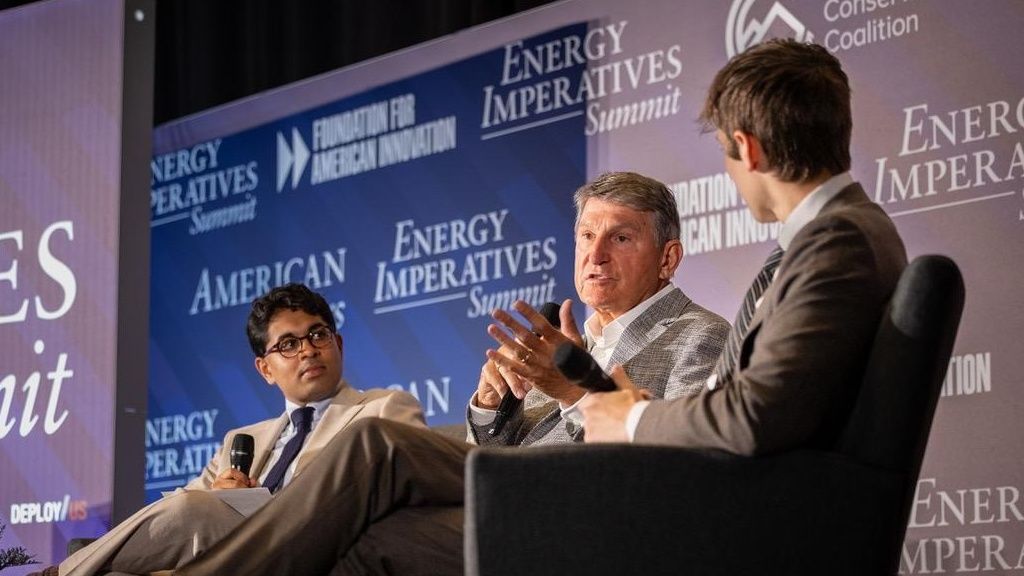
With American Affairs and the American Conservation Coalition, we hosted the second Energy Imperatives Summit, a two-day forum on restoring American energy dominance. The event had more than 450 guests, featured several members of Congress, and drew participants from federal agencies including the Department of Energy, the Nuclear Regulatory Commission, and the State Department. You can listen to former Senator Joe Manchin’s remarks at the Summit on our podcast Right of Way.
We joined 1DaySooner for Clinical Trial Abundance, a symposium on reforming the clinical trial ecosystem to accelerate medical progress through innovative trial design, data generation and transparency, and more.
The Science and Innovation team partnered with American Policy Ventures and Renaissance Philanthropy to host a lunch discussion about reforming the National Science Foundation.
Other highlights among the events our scholars spoke at include the following:
- Soren spoke on a panel hosted by the University of Virginia’s Miller Center about Emergency Powers: Presidents Unleashed?
- Dean and Tim spoke on a panel about Institutional Disruption and the Longer View at Harvard’s Berkman Klein Center for Internet & Society.
- Sam Hammond spoke at the National Security Institute’s event for congressional staffers about AI on the Battlefield: Guardrails, Government Authority, and the Future of Public-Private Defense Partnerships.
- Emmet and Non-Resident Senior Fellow Madison Hilly spoke at the Chicago Energy Conference, hosted by the University of Chicago and Northwestern University.
- Soham joined a panel on “Policy, Governance, and Civil Liberties,” at “Who Is Real Online? Personhood, Privacy and Trust Infrastructure in the Age of AI,” a conference hosted by Georgetown's Center for Security and Emerging Technology.
- Dean discussed the future of AI at the CNBC CEO Council Summit.
- Blaine participated in a debate hosted by BlueDot Impact and Portal Innovations asking, Should We Pause Development of Frontier Models?
- Sam Roland spoke at the Manifest conference in Berkeley about the tensions between Anthropic and the Department of War.
Podcasts
On The Frontier, Tim brought on experts from FAI and beyond to discuss each week’s news in tech, tech policy, and more. Recent episodes have considered the CCP’s information ops, AI-driven risks in biosecurity, and the El Segundo hardware hub.
On Nuclear Barbarians, Emmet interviewed the Fusion Industry Association’s Andrew Holland and others.
Book Recommendations
The FAI team has been getting into some great books in recent months. Here are a few that colleagues recommend:
- The Human Condition, by Hannah Arendt
- The Map and the Territory, by Michel Houellebecq
- Lords of Finance: The Bankers Who Broke the World, by Liaquat Ahamed
- The Secret Agent, by Joseph Conrad
- The Death and Life of Great American Cities, by Jane Jacobs
- The Obsolescence of the Human, by Günther Anders
- Vanity Fair, by William Makepeace Thackeray
- Always with Honor: The Memoirs of General Wrangel, by Pyotr Wrangel
- The Thirty Years War, by C. V. Wedgwood
- Brave New World, by Aldous Huxley
- The Ruling Class: How They Corrupted America and What We Can Do About It, by Angelo M. Codevilla
- Too Like the Lightning, by Ada Palmer
- The Conduct of Life, by Ralph Waldo Emerson
You can also see a longer list of our recommendations on our Bookshop page.
Conclusion
We have many projects in the works and are excited about the next few months. Be sure to get your ticket for the American Innovation Gala on October 1!
Thank you for following our work. We appreciate your continued interest in FAI and welcome any questions or feedback.
Sincerely,
Grace Werner
Vice President of Growth
Foundation for American Innovation