
Dear friend of FAI:
As we close out 2025, I’m excited to share our last quarterly update of the year and reflect on our impact, growth, and success. The FAI team continues to strengthen national security, improve American governance, and keep America at the forefront of technological dynamism.
The numbers tell part of the story. Our headcount nearly tripled; we published more than 300 pieces of research and commentary; we hosted thousands of policymakers, technologists, hackers, founders, and investors at our events; and we sent dozens through our talent development programs. But the real measure is policy impact. Our scholars helped shape federal law, executive orders, and state legislation—and we’re excited for the impact they’ll continue to have in the years to come.
As we look forward to 2026 and beyond, our task will be sustaining this momentum while building the institutional infrastructure that supports our policy and talent work at scale. The scrappy outsider phase is over. FAI is becoming what it set out to be: the center-right's primary vehicle for shaping America's techno-industrial future.
This quarter brought that trajectory into sharp focus.
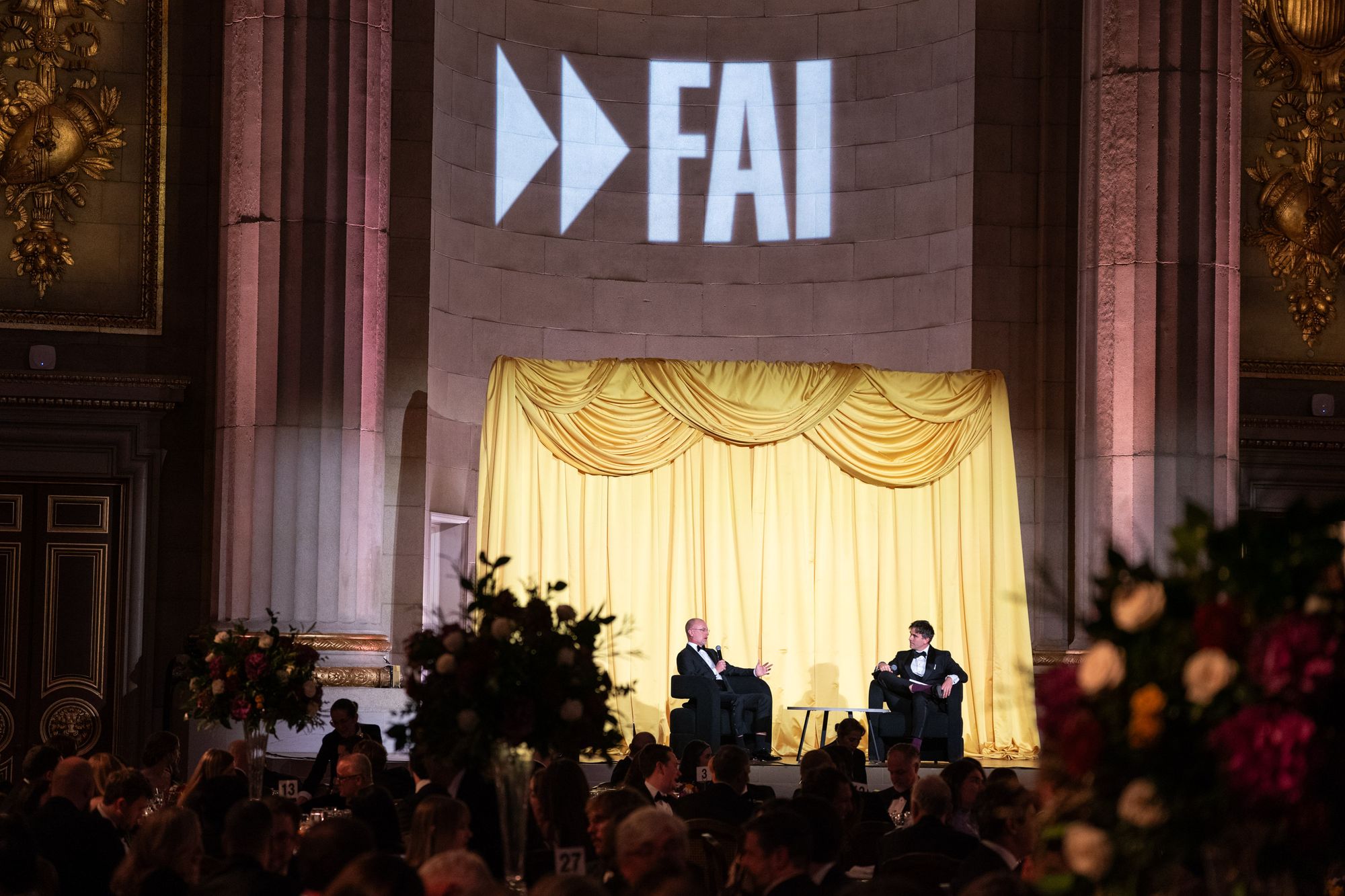
We held our American Innovation Gala on November 13 in Washington, DC. Featuring Energy Secretary Chris Wright, Office of Personnel Management Director Scott Kupor, Federal Communications Commission Chairman Brendan Carr, and 2025 Nobel Laureate in Physics John M. Martinis, the sold-out gala honored the people and ideas shaping the future of the American experiment.
Highlights from our scholars this quarter include testifying before the House Committee on Foreign Affairs on export controls, publishing two supplements to last year’s State Permitting Playbook on nuclear power and behind-the meter power, and contributing two essays to the latest issue of the journal American Affairs.
The team continues to grow. This quarter we welcomed Research Fellow Sophia Bulla, Senior Advisor Aidan Wheeler, Research Fellow Soham Mehta, Policy Advisor Pavan Venkatakrishnan, Program Manager Alex Friedland, Research Fellow Michael Lachanski, Non-Resident Fellow Nicole Ruiz, and Non-Resident Fellow Sam Manning. We also have a number of positions open—if you think you might be a good fit, please consider applying.
And if you’re still looking for a few last-minute Christmas present ideas, just consult FAI’s handy 2025 tech right gift guide!
Research
Reports, Testimonies, and Letters
Senior Fellow Dean Ball testified before the House Committee on Foreign Affairs on "Export Control Loopholes: Chipmaking Tools and Their Subcomponents." He argued that in semiconductor manufacturing equipment export controls, the U.S. bears substantial costs to domestic firms while doing little to restrain Chinese advancement in the field, and he proposed reforms to address these dual problems.
Director of Tech and Telecom Policy Luke Hogg wrote “Web of Dependencies: A History of American Tech Companies’ Complicity in China’s Techno-Authoritarian Agenda,” a study of how major players in the U.S. tech industry with ties to the federal government have operated in China in ways that conflict with U.S. strategic interests and values. He offers company scorecards on Apple, Amazon, Cisco, Google, HP, IBM, Intel, Meta, Microsoft, Oracle, and Qualcomm, and exposes a persistent misalignment between the actions of American tech firms and the strategic and moral objectives of the United States.
Research Fellow Sam Roland, Senior Fellow Emmet Penney, and Research Fellow Daniel King wrote two supplements to last year’s State Permitting Playbook. In the nuclear energy supplement, Sam and Emmet identify four areas for state-level nuclear regulatory reform: state-level moratoria and waste restrictions; uprates at existing reactors; state portfolio standard reform; and general reforms in siting, workforce preparation, and coordination with federal policy. In the behind-the-meter power supplement, Daniel identifies opportunities for state reforms to ensure that behind-the-meter and colocated energy can be deployed quickly, safely, and without shifting costs to other customers.
Sam Roland wrote a report, “Simple, Cheap, Effective, and Scalable: A Plug-and-Play Model for State Permitting Transparency,” arguing for a single, public-facing “permit transparency” platform across states. He proposes a plug-and-play model that other states can adopt, grounded in four design principles: simplicity, cheapness, effectiveness, and scalability.
Emmet and Non-Resident Senior Fellow Madison Hilly wrote “Fleet-Scale: The Case For Large Modular Reactors,” arguing for the role of large light-water reactors in the next phase of nuclear deployment. As they show, LLWRs can help capitalize on the growing consensus around the need to build out the American nuclear fleet and address the nation’s mounting energy challenges.
General Counsel and Senior Fellow Tim Hwang filed an amicus brief regarding Thomson Reuters et al. v. Ross, on the topic of how fair use should apply to cases of developers copying text at a nonpublic, intermediate stage to train AI models. He argues that the Court should adopt a factor-one standard (nonpublic, purpose-distinct intermediate use; and copying no more than reasonably necessary).
Research Fellows Lars Erik Schönander and Kevin Hawickhorst contributed essays to the fall issue of American Affairs. In “Capitalizing Main Street: The Past and Future of Small Business Investment Companies,” Lars makes the case for reforming the SBIC program, which provides federal subsidies to investment firms, so that it can continue to help small businesses grow. In “Personnel Is Policy: The Fabric of Government Organization,” Kevin looks at the history of government personnel reform and offers lessons on rebuilding government competence today.
We published a report by engineer and founder Anton Troynikov, “American Gigawatts: How to Unlock the Grid, Fast-track AI, Keep Prices Low—and Make Datacenters Pay for It.” He explains how targeted technical and policy interventions can unlock the electricity needed to power American AI while keeping rates low and modernizing the grid by correcting the misaligned incentives between the operators of the electrical grid and data-center developers.
Non-Resident Fellow Sam Manning wrote “Understanding AI’s Labor Market Impacts: Opportunities for the Department of Labor’s AI Workforce Research Hub.” America’s AI Action Plan directed the Department of Labor to establish an AI Workforce Research Hub to study AI’s labor effects. Sam proposes several options for the Hub to collect data and enable frequent analyses so that policymakers can be agile in planning for, and responding to, the workforce impact of advanced AI.
Chief Economist Sam Hammond submitted a comment to the Office of Science and Technology Policy on statutes, regulations, and other administrative obstacles hindering the adoption of AI within the United States. He argues that reaping the benefits of AI will require accelerating the adoption of new AI-enabled processes and applications, and that diffusing existing AI capabilities throughout the economy will be essential for defending against various forms of AI use and misuse.
Director of Energy and Infrastructure Policy Thomas Hochman and Non-Resident Senior Fellow Jack Andreasen Cavanaugh submitted a comment to the Environmental Protection Agency on the proposed repeal of the Greenhouse Gas Reporting Program. They urge the EPA to reconsider a proposed amendment to the GHGRP and instead focus on modernizing it to protect America’s competitive edge.
Director of AI Policy Sophia Brown-Heidenreich submitted a comment in response to the Census Bureau’s proposed revision to the Annual Integrated Economic Survey. She applauds the Bureau’s modernization goals while recommending that the AIES include basic coverage of AI investments to ensure that it captures the most important variables affecting the U.S. economy.
Daniel King testified before the Wisconsin Assembly’s Committee on Science, Technology, and AI, discussing reforms to accelerate data center siting, unify permitting criteria, and ensure that beneficiaries cover the costs of construction.
Director of Science Policy Ian Banks led a coalition letter to the Office of Science and Technology Policy, signed by senior leaders from non-traditional science institutions and bipartisan think tanks, affirming the value of public science funding and supporting new models of science funding.
Tim submitted a letter to the Office of the Solicitor General regarding Percipient.ai v. United States, arguing that the case’s outcome conflicts with the plain text of a statute that passed unanimously in Congress, President Trump’s executive orders, and Secretary of War Hegseth’s defense reform agenda.
Commentary and Impact
Policies that our scholars have engaged on saw progress this quarter.
Lars and Senior Fellow Dan Lips have been arguing for years for the need to improve transparency around the foreign funding of U.S. colleges and universities. In particular, they've called for strengthening Section 117 of the Higher Education Act of 1965, which requires postsecondary institutions to disclose payments from foreign sources. To that end, the Department of Education has announced a new foreign funding reporting portal, set to launch in January 2026, through which colleges and universities will need to disclose their foreign source gifts and contracts with a value of $250,000 or more annually to the Department. This portal mirrors the online dashboard we created as a “minimum viable product” example of how the Department could publicly report these disclosures.
Earlier this year, Dan Lips made the case that “Congress should rescind unspent COVID-19 relief funds.” To that end, Senator Joni Ernst recently introduced the Returning Unspent COVID Funds Act to rescind $65.5 billion, and she and Senator Ted Cruz introduced the RECAPTURE Act to rescind unspent funds from the Broadband Equity, Access, and Deployment (BEAD) program.
In a push led by Emmet, the energy and infrastructure team worked with grassroots activists in Springfield, Illinois, to persuade the legislature to vote for a repeal of its decades-old moratorium on nuclear energy. After several attempts, the moratorium finally passed in October 2025 as part of the Clean and Reliable Grid Act.
Throughout the year, Thomas has been calling for treating the Fiscal Responsibility Act’s definition of “major federal action” as excluding pure federal financial assistance below a threshold from NEPA. This view was reflected in the Loan Programs Office’s reported shift away from requiring NEPA for its loans.
Research Fellow Josh Levine has written about the need to accelerate the construction of submarine cables, particularly with potential allies and in contested regions, such as the Pacific. The National Defense Authorization Act makes progress on this front, directing the Development Finance Corporation to consider opportunities to support investments that would promote and secure undersea cables and other telecommunications investments.
Our commentary included the following:
- Kevin Hawickhorst, “The First Prophet of Abundance,” in Asterisk
- Samuel Hammond, “No Blackwell Chips for Beijing,” in the American Conservative
- Dean Ball, “The Hidden Legal Engine of Progress — from Railroads to AI,” in Big Think
- Josh Levine and Prineha Narang, “America’s Quantum Manufacturing Moment,” in War on the Rocks
- Josh Levine and Prineha Narang, “The Supply Chain Chokepoints in Quantum,” in War on the Rocks
- Josh Levine and Prineha Narang, “Igniting the American Quantum Economy,” in War on the Rocks
- Josh Levine and Prineha Narang, “The Genesis Mission and Quantum Technologies,” in War on the Rocks
- Robert Bellafiore, “The Right Needs a Tech Philosophy,” in Tom Klingenstein
- Kevin Hawickhorst, “To Defeat the Bureaucracy, Embrace Bureaucracy,” in Hypertext
- Lars Erik Schönander, “America’s Missing Consumer Drone Market—And the Steps to Build One,” in the National Interest
- Josh Levine and Edward Cimerman, “Security Under the Sea: Improving US Submarine Cable Repair Capacity,” in the National Interest
- Josh Levine and Prineha Narang, “Laying the Foundation for America’s Space Future,” in Space News
- Tim Hwang and Quade MacDonald, “Special Economic Zones for Restoring American Space Dominance,” in Space News
- “Congress Can Hold App Stores Accountable,” in the Daily Caller
- Dan Lips, “A New Strategy to Promote Innovation in Education,” in American Thinker
- Dan Lips, “How Transparency in National Education Statistics Can Improve Learning Options,” for the Thomas B. Fordham Institute
- Richard Reisman, “Attention Is Power,” in Persuasion
- Evan Swarztrauber, “Federal Software Needs a DOGE Makeover,” in the Washington Reporter
- Richard Reisman, “Reframing The Future of Free Speech in The Online Era,” in The Bedrock Principle
- David Cowan, “The Canningite Tradition,” in Engelsburg Ideas
- Evan Swarztrauber and Luke Hogg, “The $100 Billion Question Nobody’s Asking: Why Are Taxpayers Funding Big Tech Contracts With Nothing to Show for It?” in the Daily Signal
- Pavan Venkatakrishnan, “A Step Toward America’s All-of-the-Above Energy Future,” in The Blue Dog Bark
- Luke Hogg, “The Fight for Open Banking”
- Evan Swarztrauber, “Congress Can Meet the Moment on Kids’ Online Safety”
- Roslyn Layton, “The International Trade Commission Has Become a Tool in China’s Lawfare Campaign”
- Thomas Hochman and Jack Andreasen Cavanaugh, “The Foundational Role of the Greenhouse Gas Reporting Program (GHGRP) in U.S. Energy and Economic Competitiveness”
- Josh Levine and Prineha Narang, “DARPA’s QBI Cuts Through the Quantum Hype”
- Dan Lips, “A Bipartisan Bill to End Unnecessary Federal Spending on Software Licenses”
- Dan Lips and Soren Dayton, “Congress Should Reform the Government Accountability Office for the Twenty-First Century”
Our writers were also busy on their Substacks and blogs:
- At Green Tape, Thomas wrote about Three Mile Island and the Loan Programs Office.
- At Legislative Procedure, James wrote about earmark disputes and the filibuster.
- At Policy Gradients, Daniel King wrote about AI data centers.
Highlights among our media hits included the following:
- Dean appeared on Bloomberg's Balance of Power show to discuss the growth and regulation of AI.
- Sam Hammond joined Steve Bannon’s WarRoom to discuss AI and competition with China.
- NBC News quoted Executive Vice President Max Bodach on how the backlash to AI might shake up political coalitions.
- The LA Times quoted Sam Hammond on dynamics around stock market investment in AI.
- The New York Times and Wall Street Journal quoted Non-Resident Senior Fellow Prineha Narang on recent advancements in quantum computing.
- The Wall Street Journal quoted Dean on China's new export controls on rare earth minerals.
- Politico quoted Luke on China's efforts to set international standards in the telecom industry.
- Fortune quoted Dean on the leverage China has gained over the global economy through its control of rare earth minerals.
- Thomas spoke to the New York Times about permitting barriers to powering manufacturing.
Fellowships
We’re set to kick off the second round of the Conservative AI Policy Fellowship, our eight-week, part-time program for conservative policy professionals in Washington, DC, seeking to understand AI and the policy debates surrounding emerging technology.
The new fellows represent Congress, the executive branch, think tanks, and industry. Over the course of the fellowship, they will hear from experts on a variety of AI-related policy issues, from compute governance and energy requirements to AI’s social implications and national security threats.
Events
This quarter, we hosted events with some of our favorite organizations and thinkers.
We partnered with the Massive Data Institute and the Internet Archive at Georgetown University for Wayback to the Future: Celebrating the Open Web Past, Present, and Possible. Luke moderated a discussion about the history of the internet and ways to keep the web free, open, and innovative.
We continued our Moonshots series, cohosted with the Institute for Progress, with a Sputnik Party, bringing together innovators and wonks to recognize the anniversary of the Sputnik launch.

In Los Angeles, we hosted Launching the Next Space Age to celebrate the opening of Factory One, a new production facility that will serve as the new headquarters for satellite manufacturing startup Apex.
Podcasts
On The Dynamist, Non-Resident Senior Fellow Evan Swarztrauber brought on some of today’s most important thinkers and doers to discuss the future of technology, governance, and innovation. Recent episodes have featured Federal Communications Commission Chairman Brendan Carr and Matt Perault and Jai Ramaswamy of Andreessen Horowitz.
On Nuclear Barbarians, Emmet brought on the Nuclear Energy Institute’s Benton Arnett, the Texas Nuclear Alliance’s Andrew Kirima, and hard science fiction comic book writer Aubrey Sitterson.
On Politics in Question, James interviewed The Government Affairs Institute’s Matt Glassman and others.
On Right of Way, Thomas and Pavan hosted the Permitting Council’s Emily Domenech, Politico’s Joshua Siegel, and other players in the ongoing permitting reform negotiations.
Book Recommendations
The FAI team has been getting into some great books in recent months. Here are a few that members of the team recommend:
- Present at the Creation: My Years in the State Department, by Dean Acheson
- Orality and Literacy, by Walter J. Ong
- Christendom Destroyed: Europe 1517-1648, by Mark Greengrass
- Diplomacy, by Henry Kissinger
- The Birth of Biopolitics, by Michel Foucault
- There Is No Antimemetics Division, by qntm
- Philosophy of Mind, by Edward Feser
- Shakespeare: The Invention of the Human, by Harold Bloom
- The Rise and Fall of the Great Powers: Economic Change and Military Conflict from 1500 to 2000, by Paul Kennedy
- The Book of the Courtier, by Baldesar Castiglione
You can also see a longer list of our recommendations on our Bookshop page.
Conclusion
As we look to the new year, we’re energized by the breadth of work already underway and the opportunities ahead. The next few months will feature new research, ideas, and initiatives that build on our progress and set the tone for an ambitious year.
Thank you for following our work. We appreciate your continued interest in FAI and welcome any questions or feedback.
Sincerely,
Zach Graves
President & CEO
Foundation for American Innovation