
Dear friend of FAI,
I’m excited to share with you our recent work at the Foundation for American Innovation. It’s been an energetic quarter, and the FAI team continues to strengthen national security, improve American governance, and keep America at the forefront of technological dynamism.
As I noted in a January review of 2025, last year was a remarkable year of growth and impact for FAI. We significantly grew our staffing, revenue, and standing, reflecting a broader shift in how policymakers, technologists, and funders now engage with us. Now, in 2026, we are focused on executing our mission and vision at scale while retaining our startup roots.
To that end, in March we launched FAI Action, a new 501(c)(4) advancing energy and AI policy. FAI Action will help advance the policy innovation, coalition-building, and government affairs efforts that enhance American competitiveness.
The team continues to grow. This quarter we welcomed Vice President of Growth Grace Werner, Senior Fellow Josh Wentzel, Research Fellow Blaine Dillingham, Program Manager JéAnaïs Mitchell, Program Manager Cody Matteson, Non-Resident Senior Fellow Kevin Bardosh, Non-Resident Fellow Joseph Postell, Non-Resident Fellow Max Dauber, and Non-Resident Fellow Amelia Michael. We also have a number of positions open—if you think you might be a good fit, please consider applying.
A bigger team needs a bigger office, and we will soon be moving into our new DC headquarters on Capitol Hill—more details to come.
We’re getting ready for our American Innovation Gala, to be held on October 1 in Washington, DC. It will be an evening honoring the people and ideas shaping the future of the American experiment. Tickets and sponsorships are available; we hope you can join us.
Research
Reports, Comments, and Testimonies
General Counsel and Senior Fellow Tim Hwang and Research Fellow Sam Roland filed an amicus brief in support of Anthropic’s emergency stay motion in Anthropic v. U.S. Department of War. They argue that all American companies, including Anthropic, are entitled to a fair process, as set out by Congress, before the government can exclude them from federal contracting on national security grounds.
Senior Fellow Dan Lips and Director of American Governance Policy Soren Dayton published “Reforming GAO for the Twenty-First Century: Achieving Fiscal Savings and Increasing Government Efficiency.” The upcoming nomination of a new comptroller general to lead the Government Accountability Office offers a chance to improve GAO’s effectiveness. Dan and Soren provide recommendations for strengthening the government watchdog amid declining impact and growing political opposition.
Director of Artificial Intelligence Policy Sophia Brown-Heidenreich contributed a review of Dwarkesh Patel’s The Scaling Era: An Oral History of AI, 2019–2025 to the latest issue of American Affairs. “Between Hype and History: Conversations with the AI Elite” argues that understanding what’s currently transpiring in the companies producing frontier AI requires a presence in the room with the engineers building it.
Sam Roland and Research Fellow Daniel King published “Grid Policy for the AI Demand Surge.” They argue that as data center electricity consumption skyrockets, the U.S. grid will not be able to handle demand and our dysfunctional permitting system will drive new demand off-grid. They offer recommendations for cutting time-to-power, allocating risk, and enabling transmission to achieve a strong, cheap, growing grid.
The American Governance team released a website, Plain Job Titles, Please. Federal agencies have been ordered to stop using unclear job titles, with the Office of Personnel Management singling out the title IT Specialist as especially bad. To track compliance, the site’s counter goes up every day federal agencies avoid posting a job listing for an IT specialist, resetting to zero when they use the forbidden title.
Dan published “An Efficiency Agenda for Congress,” offering a comprehensive plan for how the legislative branch can make taxpayer funds go further by making the government work better. Complementing his 2024 report, “An Efficiency Agenda for the Executive Branch,” Dan considers reforms to address fraud and misspending, unobligated funding, outdated federal IT, federal civil service reform, and other areas.
Soren and Senior Fellow James Wallner published “Rebuilding Congress from Within: How Factions Facilitate Deliberation and Lawmaking.” They argue that Congress’s dysfunction is primarily a failure not of expertise or goodwill, but of internal organization, and that factions can help decentralize Congress’s decision-making process.
We published “An Allied World on the American AI Stack: A Strategy for Export Leadership,” by Anton Leicht and Sam Winter-Levy of the Carnegie Endowment for International Peace, Sarosh Nagar of University College London, and Liam Patell of GovAI. The paper offers a plan for anchoring global AI diffusion to the American stack, embedding U.S. technology and standards before credible alternatives emerge. The authors argue for a focused, high-impact exports program targeting treaty allies and critical swing states in the Global South.
Anton and Senior Fellow Dean Ball published “The Race Worth Winning: Middle Powers in the Age of Machine Intelligence.” Released to coincide with the India AI Impact Summit, the paper argues that the nations with the most to lose or gain from AI will be the middle powers: nations with significant institutional and industrial capacity but without frontier AI development capability. They consider how the middle powers will need to seize the AI opportunity if they are to avoid allowing the legitimacy of the state to erode or waiting for a sovereign solution that never arrives.
Soren and the American Governance Institute’s Daniel Schuman published “The Appropriations Playbook: How Policy Entrepreneurs Advance Proposals into Law.” The playbook is designed to help advocates successfully lobby lawmakers in the appropriations process by teaching them where the most important decisions are made and who makes them. The paper received a write-up in Politico Pro.
Research Fellow Michael Lachanski published “Kurzweilomics Revisited,” an assessment of Ray Kurzweil’s prediction that the path to a post-AGI future will lead to substantially above-trend income growth. He argues that Kurzweilomics does not offer a credible reason to ignore America’s unsustainable fiscal position, and that the median American will experience only a modest improvement in quality of life, as measured through real GDP per capita, over the next decade.
Former Research Fellow Bennett Tomlinson published “Data Center Security Standards for AI: A Gap Analysis.” The report surveys the most widely used information security and data-center-specific security standards and attempts to determine where their underlying assumptions about architecture, points of security enforcement, and visibility break down when applied to the AI context. Bennett offers near-term recommendations to correct the gaps until an AI-specific data center standard is developed.
Tim, along with independent consultant Chris Papasadero and Reason Foundation’s Jacob Rich, published “The Nicotine Opportunity: Military Readiness and Smoke-Free Tobacco.” They argue that the Department of War should amend its blanket ban on tobacco and distinguish between combustible and non-combustible delivery, in light of the readiness benefits of transitioning to smoke-free products.
Director of Energy and Infrastructure Policy Thomas Hochman published “The Pollution Border Adjustment Mechanism.” He argues that American manufacturers have long operated at a disadvantage against foreign competitors who are not required to control their pollution. To resolve this regulatory arbitrage, he proposes the Pollution Border Adjustment Mechanism, which would apply fees to imported goods based on what it would cost those foreign producers to meet existing Clean Air Act standards.
FAI partnered with the National Association of Manufacturers to publish “America on Hold: How Permitting Delays Stall Manufacturing Progress.” To provide a comprehensive view of permitting’s burden on manufacturers, FAI and the NAM conducted a survey of the NAM’s members to identify which projects manufacturers are undertaking, which permits they most often require, where delays and uncertainty slow investment, and what reforms industry prioritizes.
Tim and Director of Technology and Statecraft Josh Levine published “The Data Crunch: Accelerating American AI through Government Data Access.” They argue that one major accelerant for AI may be an asset that the federal government is already sitting on: its own data. Josh and Tim make the case for a U.S. Data Accelerator, through which the government would increase access to data and make it AI-ready to support American AI development.
Dan, Director of Science and Innovation Ian Banks, and Managing Director for Policy Robert Bellafiore published "Winning the Talent Race: A National Strategy for Identifying and Developing America's Future Scientists and Innovators." They argue that advancing U.S. innovation and securing national competitiveness in science and technology demand a national strategy for identifying and nurturing K-12 students with the potential for high achievement.
Director of Science and Innovation Ian Banks submitted a comment in response to the Office of Science and Technology Policy's request for information on how to accelerate the American scientific enterprise. He considers how the federal government can better support the translation of scientific discoveries from academia, national laboratories, and other research institutions into practical applications.
Ian, Sophia Brown-Heidenreich, Research Fellow Sophia Bulla, Josh Levine, and Non-Resident Senior Fellow Prineha Narang submitted a response to the Department of Energy’s request for information regarding the Genesis Mission. They argue that to execute the Mission, DOE should establish a U.S. scientific data consortium to utilize the breadth of authorities available to the Department.
Josh Levine and Research Fellow Soham Mehta submitted comments to the Federal Communications Commission on its proposal attempting to reform the rules and practices related to Upper Microwave Flexible Use Service for telecommunication operators. They highlight ideas that the FCC can leverage to promote next-generation connectivity and space-based innovation.
Ian submitted a response to the Department of Energy's request for information regarding the mobilization of talent for the Genesis Mission. He argues that the Mission gives the DOE an opportunity to address two challenges—the identification of promising secondary and primary school students and the failure of STEM PhD programs to prepare graduates for the workforce of the coming decades.
Blaine, Daniel, and Soham responded to the Center for AI Standards and Innovation's request for information on the security of AI agent systems. They offer two proposals: a standardized framework for differential access to advanced AI cyber capabilities, and a technical architecture for runtime oversight, intervention, and incident reporting.
Dean submitted comments regarding the General Services Administration’s proposed “Basic Safeguarding of Artificial Intelligence Systems" clause. He argues that the clause suffers from serious deficiencies that will undermine both its own objectives and the administration’s broader AI goals.
Sophia Bulla submitted comments opposing a recent petition for reconsideration and application for review of the FCC’s Covered List expansion. She argues that the FCC is justified in putting the Chinese companies DJI and Autel on its Covered List in light of their national security risks to the U.S., and exposes the poor arguments made by DJI and Autel against their addition to the List.
Dan submitted written testimony to the House Committee on Appropriations, Subcommittee on the Legislative Branch, recommending reporting requirements to include in the report accompanying the FY2027 funding bill to increase GAO’s return on investment.
Impact
Policies that our scholars have engaged on saw progress this quarter, especially on the Energy and Infrastructure team.
FAI’s work on permitting certainty contributed to the introduction of the FREEDOM Act, a new bipartisan bill introduced by Representative Josh Harder. The FREEDOM Act would represent a major contribution to permitting certainty.
Our calls for treating the Fiscal Responsibility Act’s definition of “major federal action” as excluding pure federal financial assistance below a threshold was reflected in the Loan Programs Office’s shift away from requiring NEPA for its loans.
FAI’s work digitizing and tracking NEPA environmental impact statements was featured by the Federal Energy Regulatory Commission’s David LaCerte in a March commission hearing.
Sam Roland’s work on state permitting dashboards has led to a number of state-level successes. Tennessee and New Jersey have adopted large portions of the FAI State Permitting Dashboard framework—through direct agency implementation in Tennessee, and through executive order in New Jersey. And in Iowa, FAI worked with Rep. Austin Harris on a new bill that would create a permitting dashboard for the state.
Sam Roland is working to lift restrictions on new nuclear development in New Jersey, having testified in favor of the bill to revoke the state’s nuclear moratorium, S3870. The bill passed out of committee unanimously, and we expect it to reach the governor’s desk this spring.
Daniel and Sam Roland testified before the Wisconsin Assembly’s Committee on Science, Technology, and AI on accelerating data center siting and unifying permitting criteria. Daniel and Sam have also begun assisting legislators in the state on a bill to implement large-load cost allocation, behind-the-meter power deployment, and permitting dashboards.
Josh Wentzel has been engaged in the development of proposals to harmonize and modernize federal biosecurity practices, as well as policy options for nucleic acid synthesis screening. The recent introduction of the Biosecurity Modernization and Innovation Act by Senator Tom Cotton marks a significant step in turning industry best practices into an established framework for producers of synthetic DNA and RNA.
Commentary
Our commentary included the following:
- Ian Banks and Prineha Narang, “Reimagining STEM Doctoral Training,” in Science
- Dan Lips with Michael Toth, “Full-Spectrum Education Choice,” in National Affairs
- Tim Hwang, “America Needs a New Generation of War Scouts,” in Pirate Wires
- Dean Ball, "The Pentagon-Anthropic Dispute Is a Test of Control," in The Financial Times
- Emmet Penny, “Data Centers Are Not the Villain,” in The Free Press
- Farrell Gregory, “China's Rare Earths Chokehold: A Primer,” in ChinaTalk
- Robert Bellafiore, “Spurious Minds,” in First Things
- James Wallner, “The SAVE America Act Fight is Political Theater,” in Tom Klingenstein
- James Wallner, “Congress Doesn’t Know It’s at War,” in Tom Klingenstein
- Soham Mehta, “Toward a Federal Framework for Online Age Assurance,” in Lawfare
- Zach Graves with Jeremy Harrell and Drew Bond, “How to Unleash American Energy Dominance Financing to Win on Energy and AI,” in The Washington Reporter
- Josh Wentzel, “Federal and State Policy Opportunities to Improve Indoor Air Quality,” in Health Security
- Sophia Bulla, “WhatsApp's DSA Designation Showcases Power Contest Over Tech In Europe,” in Tech Policy Press
- Luke Hogg, “Copyright and AI Policy Needs Precision, Not Panic,” in Tech Policy Press
- Farrell Gregory, “Remobilizing the American Industrial Machine,” in Commonplace
- Kevin Bardosh, “Realpolitik after WHO,” in RealClearHealth
- Pavan Venkatakrishnan, “Oil Companies Want to Keep the EPA Greenhouse Gas Reporting Program. Yes, Really,” in The Houston Chronicle
- Kevin Bardosh, “America Has an Alzheimer’s Problem. Can Trump Fix It?” in The Washington Examiner
- Sam Manning, “How Adaptable Are American Workers to AI-Induced Job Displacement?” for the National Bureau of Economic Research
- Ian Banks and Tim Hwang, “Virtue Metascience,” in Macroscience
- Madison Hilly, “With Nuclear Power, Illinois Can Lean in to What We Do Best,” in Crain's Chicago Business
- Ian Banks, “How to Accelerate American Science,” in C3
- Sam Roland, “The Last Great Electrical Buildout and Our Future”
- James Wallner, “A Senate Rules Reform Package: Empowering Senators to Participate in Debate, Offer Amendments, and Cast Up-or-Down Votes”
- Dan Lips and Soren Dayton, “Congress Should Prioritize the Comptroller General Nomination and Reform GAO”
- Dan Lips and Soren Dayton, “Congress Should Conduct Oversight of GAO during Its Leadership Transition”
- Zach Graves and Max Bodach, “FAI Experts: Blacklisting Anthropic Weakens U.S. AI Leadership”
- Blaine Dillingham and Sam Hammond, “Learning from Utah’s AI Regulatory Sandbox”
- Blaine Dillingham, “Process over Product: How a California Bill Could Make Legal Services More Expensive”
- Dan Lips, “Governors Should Lead the National Crackdown on Government Fraud”
- Sam Hammond, “The White House AI Framework Represents Real Progress”
Our writers were also busy on their Substacks:
- At The Ansible, the Technology and Statecraft team wrote about Bluesky, cloud procurement, and egress fees.
- At Hyperdimensional, Dean wrote about recursive self-improvement, the AI Impact Summit in India, and Anthropic’s conflict with the Department of War.
- At Legislative Procedure, James wrote about the SAVE America Act and the filibuster.
- At Statutory Alpha, Sam Roland wrote about state-level geothermal policy and New York’s permitting woes.
- At Policy Gradients, Daniel wrote about PJM’s annual capacity auction and orbital data centers.
- At Second Best, Senior Economist Sam Hammond wrote about the divide between AI empiricists and extrapolators.
- At State Capacitance, Research Fellow Kevin Hawickhorst wrote about the abolition of city government.
- At The Third Oikos, Non-Resident Fellow Nicole Ruiz continued her interview series looking at how families are adapting to new technologies and taking advantage of new opportunities for flourishing.
- At The Quantum Stack, Non-Resident Fellow Travis Scholten wrote about the future of quantum computing.
Highlights among our media hits included the following:
- Dean was the go-to expert on the Anthropic-DOW dispute. He appeared on The New York Times's Ezra Klein Show, CNN's 5 Things, and TBPN, and The Atlantic, Bloomberg, and Gizmodo all published interviews with him. He was also cited in The New York Times, The Wall Street Journal, Time, and Politico, among many others.
- Politico quoted Executive Vice President Max Bodach on the politics of association within the tech industry.
- Senior Fellow Emmet Penney appeared on ChinaTalk to discuss the life of Admiral Hyman Rickover.
- The Financial Times quoted Thomas on rising energy demand.
- Policy Advisor Pavan Venkatakrishnan appeared on NPR to discuss the importance of renewables in meeting energy demand.
- The New York Times quoted Thomas on the impact of the National Environmental Policy Act on U.S. manufacturing.
Fellowships
We recently concluded the second cohort of the Conservative AI Policy Fellowship, our eight-week, part-time program for conservative policy professionals in Washington, DC, seeking to understand AI and the policy debates surrounding emerging technology. The 20 participating fellows represented think tanks, government, industry, and academia. Over the course of the fellowship, they heard from experts on a variety of AI-related policy issues, from compute governance and energy requirements to AI’s social implications and national security threats.
Additionally, the inaugural cohort of the AI Policy Leadership Network (APLN) kicked off last month. APLN brings together almost 40 professionals from across the executive branch, Congress, think tanks, and industry. APLN is organized jointly by FAI, the Center for a New American Security, and the Horizon Institute for Public Service. In the coming months, fellows will engage with senior AI policy leaders through a series of off-the-record DC dinners and a trip to San Francisco.
Events
This quarter, we hosted events with some of our favorite organizations and thinkers.
We partnered with American Compass for a discussion on “Preserving Human Competence in an Age of AI,” featuring speakers from Anthropic, Google DeepMind, and OpenAI.
Our sister organization FAI Action hosted a launch party featuring remarks from Representative Josh Harder and Director of the Office of Energy Dominance Financing Greg Beard.

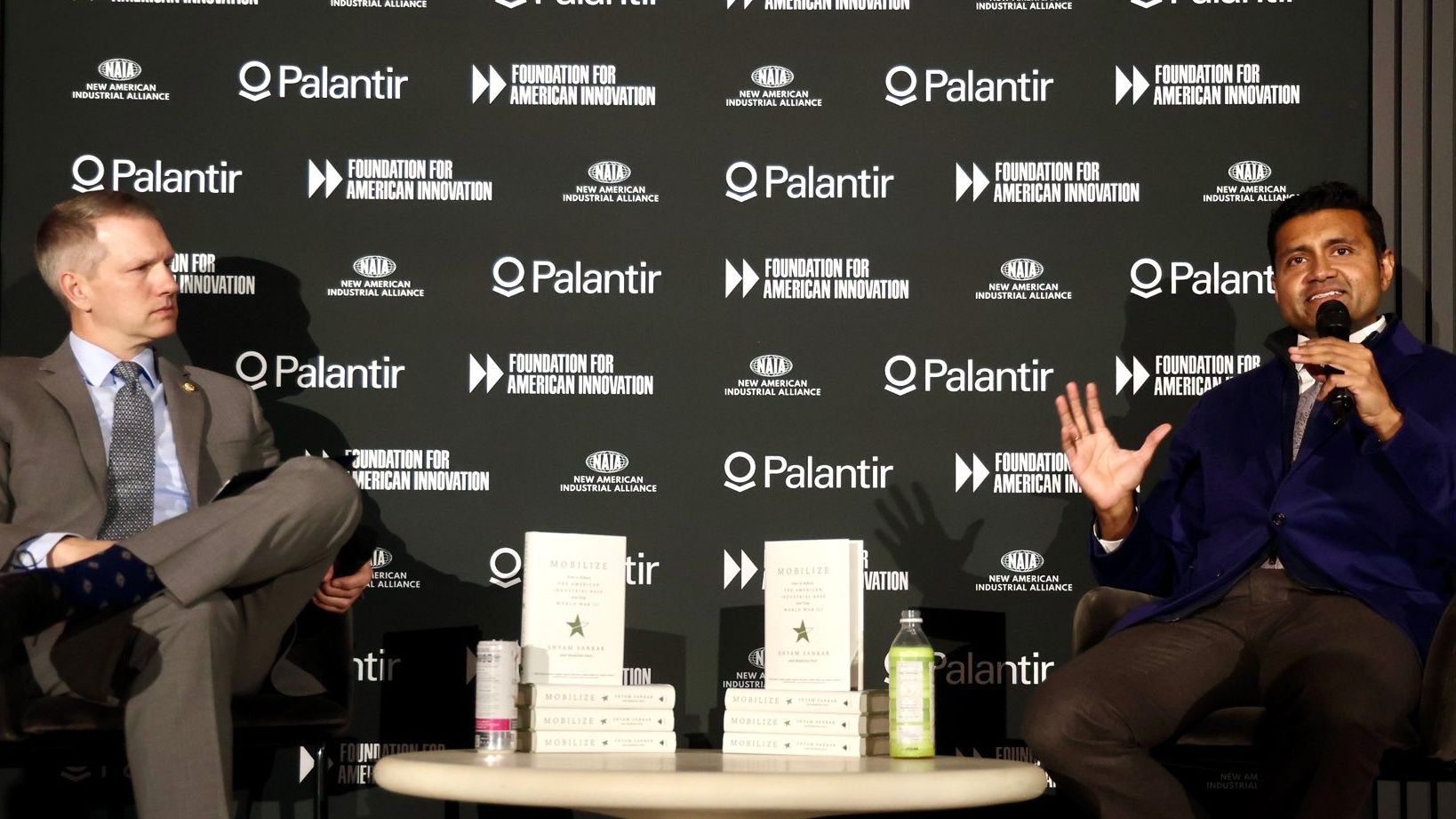
We partnered with Palantir and the New American Industrial Alliance to celebrate the release of Palantir CTO Shyam Sankar’s new book, Mobilize: How to Reboot the American Industrial Base and Stop World War III. The event featured a conversation between Sankar and Representative Riley Moore on what it will take to restore American industrial power.
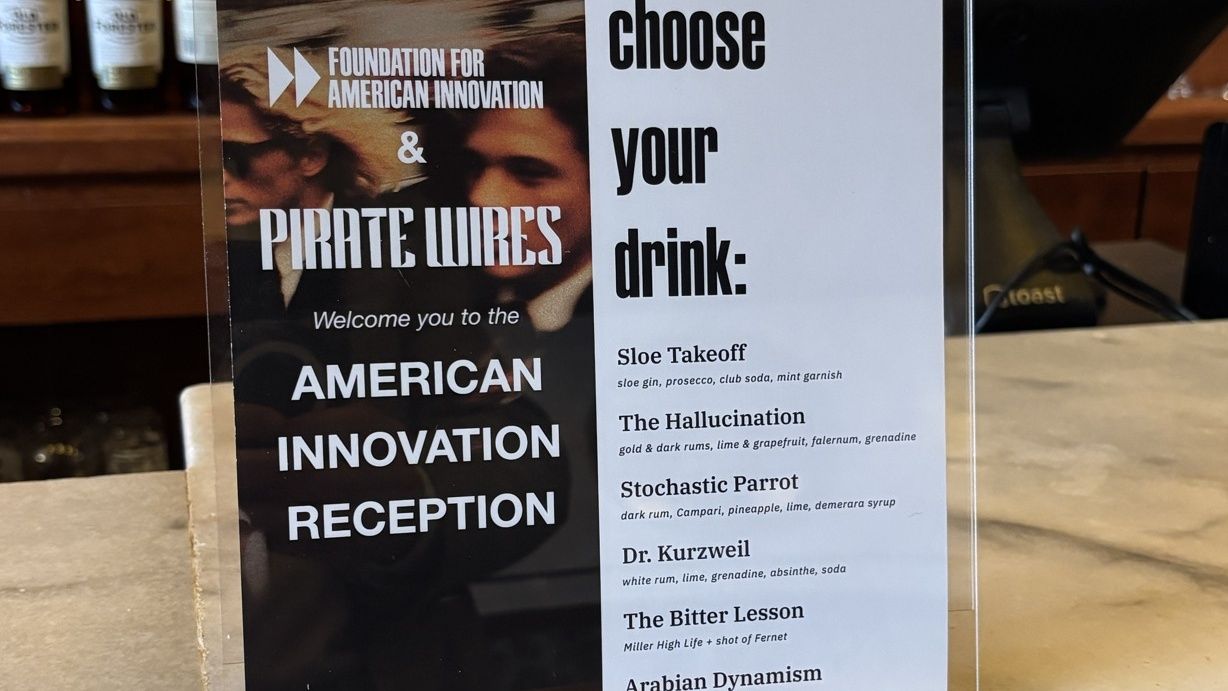
We partnered with Pirate Wires for a reception on the eve of the Hill and Valley Forum, featuring remarks by FAI board member Mike Solana. The party was mentioned by Bloomberg.

We partnered with DCVC for a salon on how to secure America's lead in quantum technologies. Attendees included deputy principles from several executive branch agencies, investors, and founders.
We hosted a salon on the opportunity to reform the Government Accountability Office during the current transition to a new comptroller general.
We partnered with IBM’s Center for the Business of Government for a roundtable discussion on government IT acquisition.
Other highlights among the events our scholars spoke at included the following:
- Dean, Sam Hammond, and I spoke at the Ashby Workshops, an invitation-only conference on the future of AI, hosted by Fathom.
- Sam Hammond spoke on a panel about Permission or Progress? AI, Regulation, and the Future of Innovation, hosted by Young Voices and the Ronald Reagan Institute.
- Senior Fellow Luke Hogg and Non-Resident Senior Fellow Richard Reisman spoke at the Knight Institute’s conference, Can Middleware Save Social Media?
- Richard spoke at a workshop on Interoperability as a Design Principle for the Digital Economy, hosted by NYU’s Stern Business School.
- Josh Levine moderated a panel on AI and competition at the Bull Moose Project’s America First Antitrust Forum.
- Daniel King spoke at a panel on “The Energy Imperative Driving the Push toward Orbital Data Centers” hosted by SpaceNews.
Podcasts
We launched a new podcast, The Frontier, in which Tim brings on experts from FAI and beyond to discuss each week’s news in tech, tech policy, and more. Recent episodes have considered the Department of War’s showdown with Anthropic, the filibuster, and the republic of science.
On Nuclear Barbarians, Emmet interviewed Exodys Energy’s Carl Perez, the Office of Energy Dominance Financing’s Julie Kozeracki, and the U.S. Army’s Jeff Waksman.
On Right of Way, Thomas brought on Representative Josh Harder.
On AI Summer, Dean and Understanding AI’s Timothy B. Lee discussed Anthropic’s conflict with the Department of War and AI safety in India.
Book Recommendations
The FAI team has been getting into some great books in recent months. Here are a few that colleagues recommend:
- The Universal Computer: The Road from Leibniz to Turing, by Martin Davis
- Richard Nixon: The Life, by John A. Farrell
- The Magic Mountain, by Thomas Mann
- Intentionality: An Essay in the Philosophy of Mind, by John R. Searle
- The Forever War, by Joe Haldeman
- The Race between Education and Technology, by Claudia Goldin and Lawrence F. Katz
- The Betrothed, by Alessandro Manzoni
- Days of Rage: America's Radical Underground, the FBI, and the Forgotten Age of Revolutionary Violence, by Bryan Burrough
- The Great Convergence: Information Technology and the New Globalization, by Richard Baldwin
You can also see a longer list of our recommendations on our Bookshop page.
Conclusion
We have many projects in the works and are excited about the next few months. Be sure to get your ticket for the American Innovation Gala on October 1!
Thank you for following our work. We appreciate your continued interest in FAI and welcome any questions or feedback.
Sincerely,
Zach Graves
President & CEO
Foundation for American Innovation