
Time is running out for the current Republican-controlled Congress. The Senate will be in session for just 22 more weeks before the November election. Lawmakers must choose how to focus their remaining time.
Republican senators should prioritize the process of identifying and confirming the nation’s next comptroller general to lead the Government Accountability Office. This role will have an outsized influence on American governance over the next 15 years.
In December, Gene Dodaro’s term as GAO's leader came to an end. Federal law requires a bipartisan, bicameral congressional commission to recommend candidates to serve as the next comptroller general to the president, who has the authority to nominate a person for consideration by the Senate. This process has taken two years for the last two vacancies.
While obscure to the outsider, the comptroller general plays an important role on Capitol Hill, serving as a watchdog for Congress. GAO conducts audits and reviews of federal programs, issues reports, and presents recommendations to the leaders of federal agencies and Congress on how to make the government work better. GAO staffers are routinely called to testify before congressional panels, and the information they provide often informs legislation and appropriations.
This is important work. And when it’s done well and used effectively by the executive branch and Congress, it can result in significant savings for American taxpayers. GAO measures its value annually in terms of financial benefits achieved for the federal government. Since 2002, the watchdog agency estimates, its work has helped save $1.5 trillion, an impressive figure for an agency that receives less than $1 billion per year.
But in recent years, GAO’s annual return on investment has been declining. In a new report issued today, GAO estimates that its work resulted in $63 billion in financial benefits to the government, yielding an ROI of $68 per tax dollar invested in GAO’s budget. This is below GAO’s 10-year average ROI of $116 for every dollar.
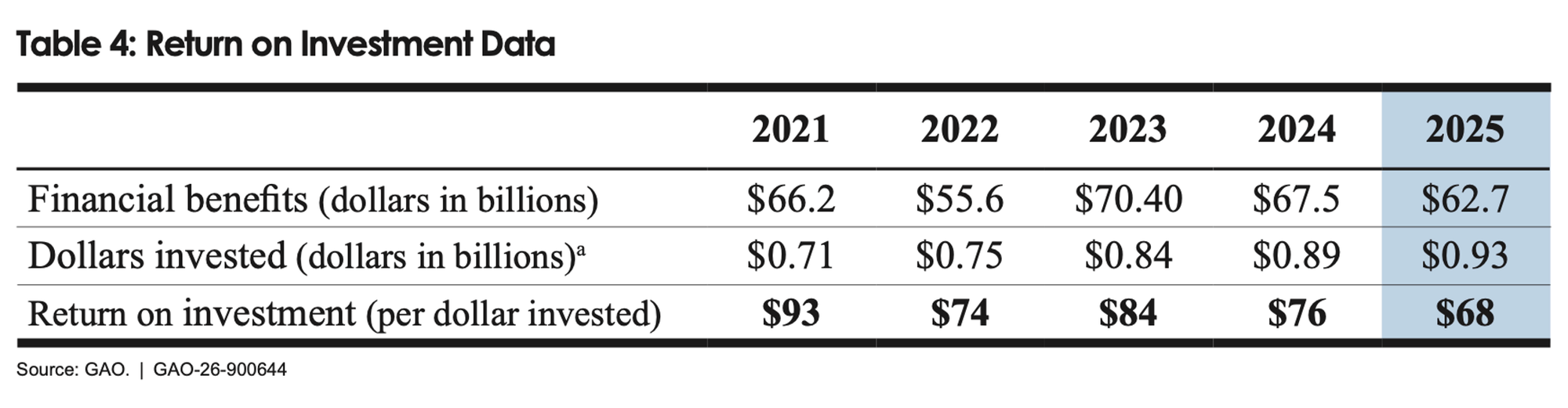
The recent decline in GAO’s ROI is disappointing and underscores the urgency of selecting a new comptroller general committed to increasing the watchdog agency’s impact.
Over the past five years, Congress has enacted a series of reforms aimed at increasing GAO’s ROI, including requiring GAO to conduct quarterly reporting on federal improper payments (which routinely exceed $100 billion annually), issue annual reports estimating potential savings that could be achieved if open recommendations for federal agencies and Congress were implemented, and even establishing deadlines for new recommendations to be implemented.
Unfortunately, GAO’s response to these congressional mandates has been halfhearted. For example, the agency has responded to the requirement to detail potential savings associated with each open recommendation for agencies by running a computer simulation. The results were eye-opening—financial benefits could total between $106 billion and $208 billion—but the agency did not provide a detailed list of all recommendations associated with potential savings, which could have provided a roadmap for reform. GAO has been slow to implement the 2024 congressionally mandated pilot project to begin including timeframes for implementing new recommendations. We recently heard from GAO that this pilot project would begin sometime in 2026, two years after Congress told them to begin it.
Considering that the former comptroller general often warned Congress that the nation was on an unsustainable fiscal path, one would hope that the watchdog agency would answer Congress’s call to provide clear direction about potential cost savings with greater urgency.
Today, GAO faces broader issues than a declining ROI. The agency has faced strong opposition from the Trump administration and some congressional Republicans, due largely to concerns about GAO’s recent actions related to its congressionally mandated responsibilities under the Impoundment Control Act and the Congressional Review Act.
But as we recently argued in our new paper, “Reforming GAO for the Twenty-First Century,” President Trump and congressional Republicans have an opportunity to identify, nominate, and confirm a new comptroller general. To that end, lawmakers can direct GAO’s next leader to be more aggressive in issuing recommendations that help Congress and the executive branch reduce government waste.
But time is short. President Reagan was the last Republican to nominate a comptroller general. With the November elections looming, Republicans should take advantage of the opportunity to set a course for GAO’s next 15 years. If control of the Senate changes hands in November, they may miss their chance.