

2025 was a remarkable year of growth and impact for FAI. We significantly expanded our staffing, revenue, and standing—reflecting a broader shift in how policymakers, technologists, and funders now engage with us. From shaping national AI policy to advancing durable reforms in energy and permitting, our work increasingly translates ideas into outcomes.
This evolution coincides with a larger reality: over the past decade, technological change has moved from the background to the center of American politics, statecraft, and economics. In this environment, FAI is focused on building permanent capacity to support American prosperity, security, and dynamism.
National coverage in 2025 reflected our transition from policy startup to institutional actor. Politico described FAI as a major force influencing the federal government’s AI agenda, while Inc. Magazine chronicled the organization’s rise from Silicon Valley roots to a position of notable influence in Washington. The Information ranked FAI among the most important think tanks in technology, reinforcing our role as a central node in innovation policy and tech culture.
2025 Fundraising
Founded in 2014 in Silicon Valley, FAI now operates from both San Francisco and Washington, DC. Over that period, we have evolved from a small startup into a national institution designed to operate at scale. In our first operating year, total revenue was just over $500,000. By 2024, annual revenue had grown tenfold to $5 million, and in 2025 increased again by fourfold to around $20 million. Our staff now exceeds 30 full-time employees, supported by 27 non-resident fellows, with additional hires underway.
This growth is a consequence of the stakes of our work. As leaders across government reenter complex and consequential policy domains, FAI functions as a vital resource for those seeking techno-realist research, policy development, convenings, fellowships, and strategy to accelerate American dynamism and human flourishing.
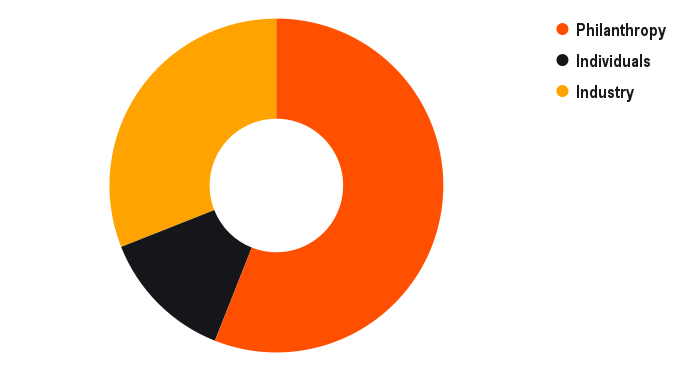
As the resonance of our mission and vision has increased, we’ve attracted durable support. In 2025, we received contributions from more than 150 donors, with a median annual gift of $25,000 and an average gift of $145,000. The majority of our funding comes from philanthropic foundations and nonprofits (56 percent), followed by industry and venture capital (31 percent), and individuals (13 percent). Per our policy, we do not accept gifts from foreign governments or entities affiliated with U.S. adversaries.
Our core support base includes a varied set of philanthropic foundations, including the Silicon Valley Community Foundation, Stand Together Trust, the Arthur N. Rupe Foundation, the John S. and James L. Knight Foundation, the Sarah Scaife Foundation, the William & Flora Hewlett Foundation, the Filecoin Foundation, the Ethereum Foundation, Arnold Ventures, the Armstrong Family Foundation, and others. We are grateful for their support and trust.
FAI’s donors are united by a shared diagnosis: that innovation now outpaces the institutions meant to govern it, and that failure to rebuild those institutions carries real risks to prosperity, security, and stability. Our funding reflects that shared assessment and seeks to underwrite excellence in execution, institutional development, and lasting policy outcomes, rather than ivory-tower research or performative donor service.
(Please note that the data in this post for 2025 is based on preliminary and unaudited year-end figures.)
2025 Programs
FAI’s program structure reflects a deliberate theory of impact: concentrate resources where technological capability, institutional capacity, and geopolitical competition intersect most sharply—domains where policy failure compounds quickly and informed intervention can alter outcomes.
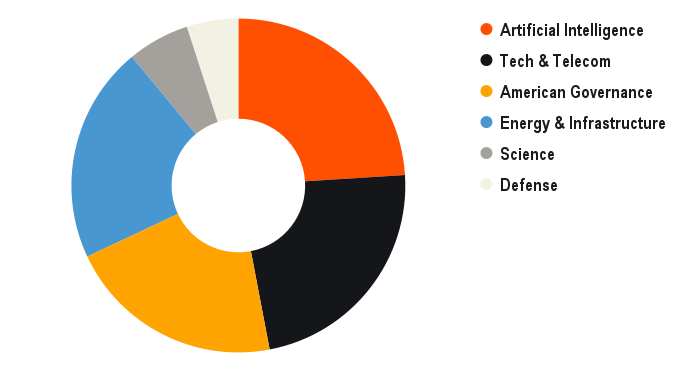
Our four largest policy program areas by funding are artificial intelligence, technology and telecommunications, American governance, and energy and infrastructure. Each reflects a core constraint on American state capacity: the ability to deploy advanced computation, maintain critical digital infrastructure, govern effectively, and deliver abundant, reliable energy. Newer program areas include science and defense and national security, where growing competitive pressures demand deeper institutional engagement.
Across our programs, we focus on creating talent pipelines, publishing impact research, providing technical input on legislative and executive proposals, shaping administrative implementation, earning new and traditional media, and building coalitions capable of carrying reforms through execution. We measure success not by publication volume, but by whether our reform ideas endure across administrations and political cycles.
FAI also serves as a convening institution across technology, government, industry, and civil society. In 2025, we hosted our second annual gala, convening more than 500 leaders from across these domains. It was emceed by FAI Chairman Laurent Crenshaw and headlined by 2025 Nobel laureate John Martinis, Federal Communications Commission Chairman Brendan Carr, and Office of Personnel Management Director Scott Kupor, with additional remarks by Secretary of Energy Chris Wright. The event had over 45 sponsors, including several AI frontier labs, energy companies, venture capital firms, startups, philanthropic foundations, and generous individuals. The event reflected FAI’s role as a venue for serious engagement among actors who rarely share the same room. Planning is also underway for the next American Innovation Gala in fall 2026.
We’re proud to say that FAI is no longer an emerging think tank. In 2026, we are focused on executing our mission and vision at scale while retaining our startup roots. You can learn more about our work and financials here. If you are inspired to support our work, you can do so here.


