On Wednesday, the House Oversight and Government Reform Committee will hold a hearing to examine duplication in government programs. Acting Comptroller General Orice Williams Brown, who took over the leadership of the Government Accountability Office from Gene Dodaro in late December, will be one of the witnesses.
Exposing duplication and waste in government programs is an important topic. But the Committee should also use the hearing to conduct needed oversight of GAO ahead of the next Comptroller General’s nomination.
GAO’s ongoing work identifying duplication in government programs is a good example of why Congress needs to take a proactive role in overseeing and directing the watchdog agency’s work. According to its latest report on duplication, GAO has recommended more than 2,000 reforms to address duplication since 2011, which has resulted in "approximately $725 billion in financial benefits,” including “an increase of approximately $57 billion” between 2024 and 2025.
But Congress must recognize that this comprehensive work to root out waste would not have happened if not for a congressional mandate. In 2023, one of us (Dan Lips) shared the background on how the GAO’s annual duplication report came to be in testimony before the House Committee on Administration’s subcommittee on modernization:
My former boss, Senator Tom Coburn, passed the mandate that established the annual report on duplication. That work, as we have heard, has been—resulted in $600 billion in savings over the past 12 years. It is important to know—according to his former staff, I was not working with him at the same time—GAO did not want to do that work until they were mandated by law. They were asked to do it. They did not want to do it, and so he passed an amendment to a debt ceiling bill, and since then, Comptroller General Dodaro has called that reporting requirement the gift that keeps on giving. I think they need to be pushed sometimes to deliver what Congress wants.
In other words, if Senator Coburn had not pushed for this work by enacting a mandate, the government could have missed out on $750 billion in savings since 2011. This history should prompt lawmakers to consider how GAO needs to be pushed today.
This moment offers an opportunity to Congress and GAO. Both can articulate more aspirational goals for GAO that can guide the priorities of a new Comptroller General. Effective oversight in this transition should accomplish several things:
1. Establish baseline performance data that can be used to measure the success of the next Comptroller General;
2. Surface institutional dysfunction that bipartisan reform can address;
3. Identify areas that the new Comptroller General can prioritize within existing statutory authorities; and
4. Make statutory changes to allow the Comptroller General and GAO to be more aggressive in fulfilling the mission.
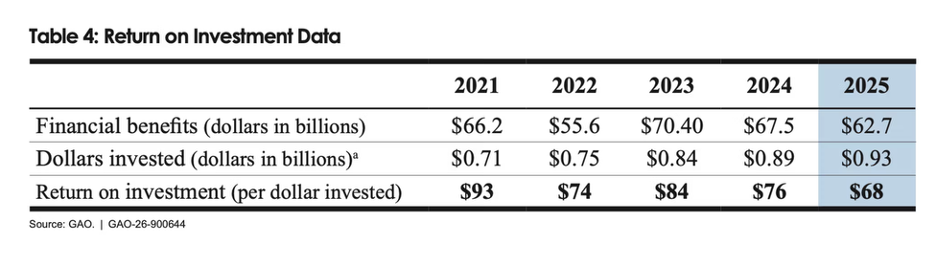
These three goals are urgent because GAO's own performance metrics reveal institutional drift. Over the past five years, GAO's return on investment has declined compared to its 10-year average ROI of $116 for every dollar provided by Congress. Without baseline data on what is causing this decline, the next Comptroller General will inherit a problem without a diagnosis.
Below, we suggest issues that members of the Oversight Committee should raise with Williams:
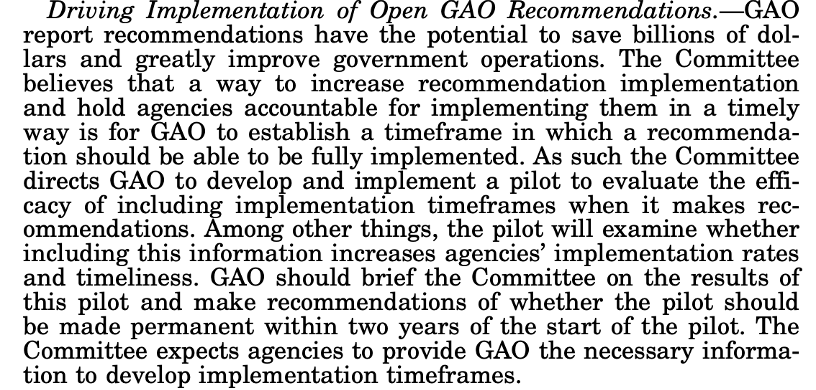
1. What is the status of the pilot project to set “timeframes” on new recommendations that Congress mandated in 2024?
In 2024, the House Appropriations Committee included the following language in its report accompanying the funding bill that includes GAO to require a pilot project to establish timeframes on new GAO recommendations. The pilot project was supposed to be made permanent within two years. But 20 months later, there’s no evidence that this pilot project has happened.
2. Why did GAO take down its public downloadable CSV file of all open recommendations? Congress should tell GAO to provide it to Congress and publish it again.*
More than 5,300 GAO recommendations are currently open, many of which have been open for longer than a decade. The agency used to publish a file on its website so that Congress and the public could review and analyze all of the open recommendations. But it has been removed. Congress should request that database and direct GAO to publish it.
3. What is the status of GAO’s staffing (including widespread remote work)?
Following its new labor agreement, GAO’s staff has transitioned to widespread use of remote work and telework. While Congress and the administration have pushed for government employees to come back to the office, many GAO staffers remain at home. Congress should request data on office attendance, as well on employees’ locality pay.
4. How does GAO justify its past and ongoing return on investment estimates?
Congress should require GAO to provide detailed information about the financial benefits achieved over the past 10 years to help Congress understand the ROI benefits. GAO’s ROI estimates are critical for understanding the value that the watchdog agency provides Congress and American taxpayers. But it would be more convincing if GAO established greater transparency about how those ROI estimates are made, such as by making these estimates fully public and allowing for a third-party analysis, such as by the Congressional Budget Office.
5. How much does the federal government waste by ignoring open GAO recommendations?
Congress should direct GAO to provide greater clarity about potential taxpayer savings that could be achieved by implementing open recommendations for federal agencies and open matters for congressional consideration, consistent with federal law and appropriations report language.
In 2022, Congress established two mandates to create transparency about how GAO reports its open recommendations for federal agencies and suggestions for Congress, including to provide estimates of potential cost savings associated with unimplemented recommendations. Congress should review how GAO has responded to those mandates and direct a comprehensive review of the open recommendations and matters for congressional consideration that could yield financial benefits for the government.
6. What is GAO’s best recommendation to stop improper payments?
In 2022, Congress directed GAO to conduct quarterly reporting on improper payments, which have totaled nearly $1 trillion over the past four years. Congress could task GAO to provide updated, clear and comprehensive recommendations for improving payment integrity and reducing improper payments.
Four years ago, the House Appropriations Committee directed GAO to conduct quarterly reporting on improper payments, given the significant potential to reduce federal misspending. Congress should direct GAO to consolidate all of its open recommendations related to reducing improper payments in a series of matters for congressional consideration.
7. Congress should direct GAO to provide any internal data about its process for answering Congressional requests.
Congress should request greater transparency about how GAO answers all its requests from Congress, including information about which requests are prioritized and why. Congress should also request transparency into the time that reports are started and published, including any reasons for potential delays, such as federal agencies resisting answering requests for information.
-----
As we have written before, Congress must prioritize the process of recommending a new Comptroller General and considering a nomination in a timely manner. A new Comptroller General will have an opportunity to update GAO’s mission for the twenty-first century. The House Oversight Committee and other lawmakers can help that process by conducting vigorous oversight of GAO during this period of transition to identify needed reforms and help the next Comptroller General succeed in the process of charting a new course for GAO.
Correction: A previous version of the blog post asked, "Why did GAO take down its public list of all open recommendations?" In the past, a user could download a CSV file with the complete list of recommendations across agencies. That file is no longer available; now a user can only access recommendations one agency at a time. FAI submitted a FOIA request asking for this file in December 2025. Without a complete database of all open recommendations for all agencies, it is difficult for Congress to determine how many recommendations were made more than a decade ago.