
Congress is missing an opportunity created by the Supreme Court’s 2024 Loper Bright decision. The Court directed judges to stop deferring to agency interpretations of statutes. But it noted that in some cases Congress really does “expressly delegate” to an agency and state the boundaries of the delegation. In those cases, the courts must respect that delegation.
This decision is a call to Congress to clearly delegate. But despite this opportunity, Congress has not acted. Not a chamber, not a committee, not the legislative drafting offices.
This post outlines one way that a congressional committee could grasp that opportunity. First, a committee should establish clear, templated language that signals the fact of a regulation, what it is for, and what its boundaries are. Second, it should include in the committee report for a bill an inventory of what regulations the committee understands to be authorized by the bill.
This proposal builds on what happens in other jurisdictions that use clear templates when writing delegations. For example, Montana requires clear communication of regulatory purposes and provides a drafting manual to the legislature that makes it clear how to do it. Maine requires that an authorization to regulate include the level of legislative review that the regulation will receive. The European Union has a system with clear templates, tools, timelines, and legislative procedure to facilitate scrutiny of regulations before they take effect.
Before detailing concrete recommendations, this post reviews briefly what Loper Bright did and how Congress has responded to a similar Supreme Court decision, INS v. Chadha.
What was Loper Bright?
In February 2020, the National Marine Fisheries Service claimed authority under the Magnuson-Stevens Act of 1976 to require fishing boats to pay for the federal observers they carried. This stretched a 44-year-old statute to cover a question its drafters never faced. The focus of commentary on Loper Bright has been on the doctrinal change.
This has been seen as an earthquake in administrative law because it overturned Chevron, another Supreme Court decision which gave deference to agency interpretations of their statutes. However, when stated as concrete facts, it is easy to see why the Supreme Court ended up where it did. While the lawyers have framed this as a crisis of court doctrine, political scientists can see it as a natural consequence of the executive extending old statutes rather than Congress and the executive working together. Courts end up allocating power because the political branches no longer do.
It is worth considering how Congress responded to Chadha, another Supreme Court decision that impacted the separation of powers.
What happened after Chadha?
How Congress responded to the 1983 Supreme Court decision INS v. Chadha provides insight into what could happen with Loper Bright.
In the 1930s, Congress began using a structure called the legislative veto. Congress delegated the power to the executive branch to take or propose a specific kind of action. Congress retained the ability to terminate it through some action. These vetoes took several forms. Sometimes, committees or their leadership could block actions. Sometimes, a single chamber of Congress could block an action. Sometimes both chambers acting together could block the action.
In 1983, the Supreme Court decided INS v. Chadha, which struck down the legislative veto in a case where one chamber of Congress had voted to overturn an executive action involving deportation. While the Court’s decision was focused on the single-chamber veto, its logic has been understood to extend to the whole framework of legislative vetoes. There had been little use of the two-chamber veto, and there was little effort to defend it.
While Chadha formally ended the legislative veto, it did not end committees’ influence over executive action. The committees that legislate every year maintained a de facto legislative veto. Armed Services and Appropriations still require agencies to seek committee approval before reprogramming funds. This requirement has been legally unenforceable since 1983. And yet it works. The Government Accountability Office’s review of the practice found that Pentagon reprogramming requests to the committees actually rose after the decision, from roughly 40 per year to nearly 70.
The enforcement mechanism is regular action, not the law. Agencies comply because these committees pass legislation every year that shapes what the agencies do.
Chadha’s aftermath suggests a path forward for the post-Loper Bright world. The Court ended deference but preserved one important category. When Congress expressly delegates discretionary authority and states its boundaries, courts respect the delegation when adjudicating cases that arise under the law. In those cases, courts will police only the boundaries. That puts a premium on how delegations are drafted.
Two years on, no chamber, committee, or drafting office has changed how it writes them. This is a proposal for how to start.
How to Delegate Clearly
I propose that a committee adopt the following template for drafting a statute that would give an agency the authority to issue a regulation.
SEC. _. RULEMAKING.
(a) In General.—The Secretary shall issue regulations establishing [specific subject], including, at a minimum—
(1) [A];
(2) [B]; and
(3) [C].
(b) Deadline.—Not later than 18 months after the date of enactment of this Act, the Secretary shall issue final rules under subsection (a).
(c) Duration.—The authority under this section terminates 10 years after the date of enactment of this Act unless reauthorized.
A clear delegation of authority could answer a set of questions:
- Who has been given the authority to do something?
- What have they been given the authority to do?
- When do they have to issue the regulation by?
- How long does the authority last?
Now, obviously the clarity of the regulation will depend on what [A], [B], and [C] say. But there is no ambiguity about the existence or authority of a regulation, like there was in Loper Bright.
A committee could have a rule that requires this format for provisions in a statute and empowers the staff to make technical corrections to legislation reported by the committee to bring them into compliance with this format. The committee report would then include a delegation inventory listing the rules the committee understands the bill to authorize.
If a bill goes to conference or is inserted in an end-of-year product, the committee leadership could fight to have that language preserved and the inventory inserted into the final report.
Some States Already Do This
Some states make it quite clear how a delegation should be drafted and even require the legislature to make particular decisions about how it will be treated after enactment.
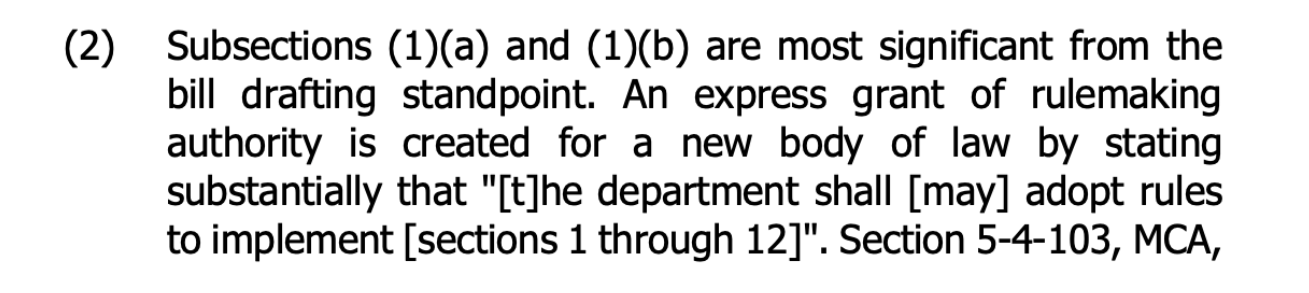
Montana requires by statute that every delegation of rulemaking authority "contain specific guidelines describing for the agency and the public what the rules may and may not contain" (Mont. Code Ann. § 5-4-103), and its drafting manual makes any bill granting rulemaking authority say so in its title.
Maine requires every grant of rulemaking authority to classify the resulting rules as "major substantive," triggering legislative review before final adoption, or "routine technical" (5 M.R.S. ch. 375, sub-ch. 2-A). This is written into the statute itself. For the “major substantive” rules, the regulation takes effect after the agency submits the rule to the legislature and the legislature fails to act on it. The required action is a “resolve” (at the federal level, this would be a “joint resolution”) rejecting the regulation, which must then be signed by the governor. (The difference between Maine’s legislative review of “major substantive” regulations and the Congressional Review Act is that the regulation only takes effect once the review period is completed. This is similar to the EU’s scrutiny and legislative veto system. Delegated act takes effect if the scrutiny period completes without rejection by either the European Parliament or the Council of the European Union.) Routine technical ones are adopted without legislative review.While the Maine process does not create templates, it makes it clear that something is a regulation. It also makes clear what process comes after the statute becomes law.
The Maine model provides a hint of how Congress could provide levels of review that are “proportional” to the regulation, in the language of conservative administrative law scholar Christopher Walker.
The states have shown that standard delegation clauses, classification elections, and duration limits are ordinary drafting practice. On this one, Congress is the laggard.
Brussels Wrote It All Down
The European Union has a very developed system for specifying and enforcing delegations. Since the Lisbon Treaty took effect in 2009, an EU law that delegates quasi-legislative power to the European Commission must explicitly define the objectives, content, scope, and duration of each delegation. There is no European equivalent of "such rules as may be necessary," the language Congress often uses when it knows regulations will need to be written.
The 2016 Interinstitutional Agreement on Better Law-Making standardizes exactly how “delegated acts,” which Americans would call regulations, should be written. The appendix to that document contains “standard clauses,” or templates that should be used when EU legislators create delegations.
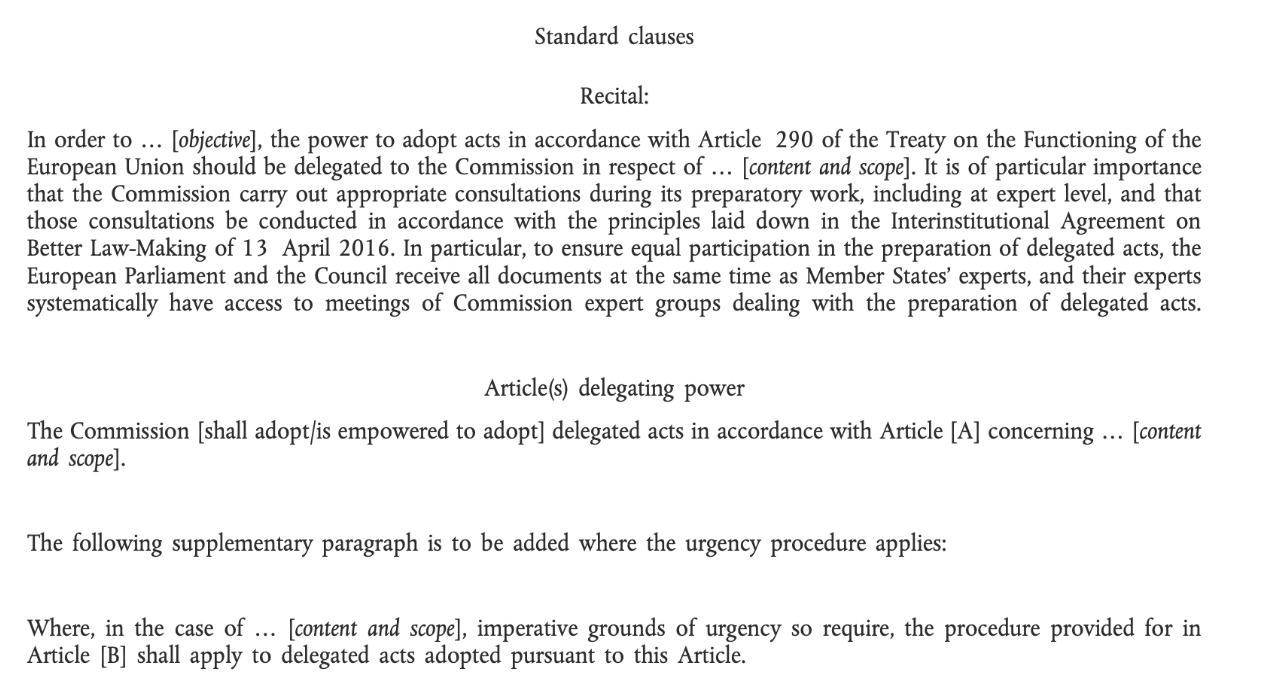
The template is formulaic. It has several components:
- What the Commission may regulate.
- How long the delegation lasts (typically five years with tacit renewal, or indefinitely)
- How the legislature can revoke it
- Which experts the Commission must consult before acting
- A two-month window in which either the European Parliament or the Council of the European Union, acting alone, can block an individual act, although they only do so in a small number of cases.
Because every delegation is drafted from the same template, the EU can easily produce a public register that lists, for each law, every regulatory power it contains, and tracks each act adopted under it. Want to know what a statute authorizes? There is a page for that. Want to know which acts have been completed? There’s a page for that too. Want to know which ones are taking comments or public meetings? There’s a page for that too.
The European Parliament did not receive this system in a grand bargain. Its committees spent the 1990s and 2000s fighting for it. In 2006, the European Parliament won a right to object. The framework was written into the 2009 Lisbon Treaty. But that treaty didn’t implement itself. There was an informal agreement to implement the treaty provision in 2011. And it was formalized in the 2016 agreement, along with the register. Codification came last after 20 years of fighting over it.
Templates + Tooling = Clarity
Templates and standard clauses are not just clear to people. They can be machine-readable, especially with artificial intelligence tools. This means that the inventory of what a bill authorizes does not have to be compiled by hand.
At the scale of a single committee, some basic AI skills and hand curation would allow a committee to review the final text of each reported bill, extract every delegation, and publish the inventory, all without hiring any additional staff.
Congress has recently built a similar tool to modernize its capacity and make legislating clearer. The Select Committee on the Modernization of Congress recommended, and the House Clerk built, the Comparative Print Suite. This automated the implementation of the House's old Ramseyer requirement, showing how a bill changes existing law. The Comparative Print Suite turns legislative language (which is really instructions to be executed on the legislative statute) into a human-readable final product.
The Comparative Print Suite made it easier to understand what the legislation actually does by lowering the cost of compliance. A simple tool built on top of template language would make it easier to understand what delegations are actually provided by the legislation.
This is exactly what the EU register does, and it adds where in the rulemaking process each delegation stands. Some are not yet started. Some are completed. Some are being worked on. And some are in the scrutiny period, where they can be rejected.
Agency general counsels would consult it to keep their rules inside the lines. Litigants would consult it for the opposite reason. And committee staff would open it at the start of every Congress and find something the institution has never had before: an oversight roadmap written by its own statutes.
A Committee Could Go First
None of this requires a statute, floor time, or an agreement with the executive branch. A committee could adopt a rule directing staff to use standard, templated language for provisions that delegate rulemaking authority. Each committee report would then include a delegation inventory listing the rules the committee understands the bill to authorize. The practice would bind only the committee's own work product and apply only going forward, which is exactly the scope of what a committee can do unilaterally.
Rackey and Bell made a similar suggestion in a chapter in FAI’s Congress after Chevron—that committees should refocus hearings on gathering implementation information from executive branch witnesses. Their suggestion uses unilateral committee action to get more information into the legislative process. This proposal uses unilateral committee action to state what the legislation means.
The drafting infrastructure is overdue for the attention anyway. The last public update of the Senate Office of the Legislative Counsel's drafting manual is dated February 1997. A committee that adopted delegation standards would give the Legislative Counsel both the template and the reason to update it. This bottom-up approach to legislative power is what happened in Europe. European legislators spent twenty years building their position through committee practice and legislative pressure before the system was finalized in 2016.
In Congress, the doctrine, templates, and precedents are all sitting on the table. What the courts and the drafting offices cannot supply is the first committee willing to pick them up.
Action comes first.